
| UN Alliance to Rescue 33M Latin American Rural Poor Orlando Milesi - Inter Press Service | |
| go to original August 29, 2017 |
 |
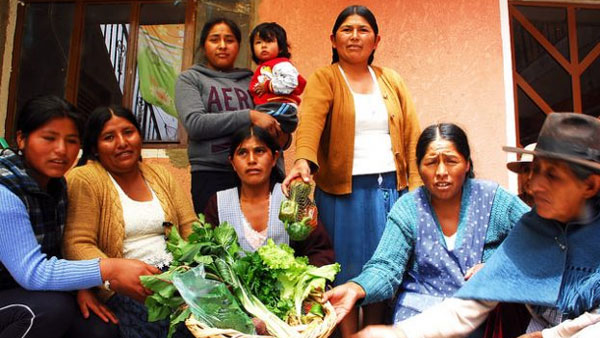
Indigenous women, such as these farmers on the outskirts of Sucre, Bolivia’s official capital, are part of a group with the most difficulties to overcome extreme poverty in Latin America, and therefore require specific policies to give them equal opportunities. (Franz Chávez/IPS)
“There are 33 million rural dwellers in Latin America who are still living in extreme poverty and can’t afford a good diet, clothes or education, and we are not going to help them move out of poverty if we use the same strategies that worked 20 years ago,” , FAO regional representative Julio Berdegué told IPS.
Since 1990, rural poverty in the region was reduced from 65 per cent to 46 per cent, while extreme poverty fell from 40 per cent to below 27 per cent.
But while the proportion of rural extreme poor decreased by 1 percentage point a year between 1997 and 2007, the rate of decrease was only 0.2 per cent a year between 2007 and 2014.
To break that pattern in the most vulnerable rural group, the United Nations’ Food and Agriculture Organisation (FAO) and the International Fund for Agricultural Development (IFAD) are launching this last week of August in Santiago, Chile the “Alliance to end rural poverty in Latin America.”
“There is a strong deceleration in the reduction of poverty, five times slower than before, only just 0.2 per cent per year,” noted with concern Berdegué, who attributed the phenomenon, among other causes, to a regional economic slowdown which has had an impact on employment and incomes.
“The strong, sustainable, solid solution to rural poverty is economic development in rural areas. Quality jobs, better wages: that is the best strategy to reduce rural poverty,” said Berdegué, who is also FAO deputy director-general, in the body’s regional office in the Chilean capital.
For Berdegué, “social policies compensate for the effects of economic development, but what we want is for people to stop being poor because they have better jobs and not because of good social programmes…that is a second best option.”
In his interview with IPS, the Mexican senior U.N. official said the region has already done a great deal to reduce poverty and extreme poverty and what remains is to eradicate the most difficult part of poverty, harder to combat because it is structural.
He cited the example of Chile, where less than three per cent of the rural population suffer from extreme poverty, but the people affected are indigenous women in remote areas, which makes the task of rescuing them from deep poverty especially complicated.
Read the rest at Inter Press Service | Español
IPS is an international communication institution with a global news agency at its core, raising the voices of the South and civil society on issues of development, globalisation, human rights and the environment. Check out the website at IPSNews.net
We invite you to add your charity or supporting organizations' news stories and coming events to PVAngels so we can share them with the world. Do it now!
Celebrate a Healthy Lifestyle
 From activities like hiking, swimming, bike riding and yoga, to restaurants offering healthy menus, Vallarta-Nayarit is the ideal place to continue - or start - your healthy lifestyle routine.
 Banderas Bay offers 34 miles of incomparable coastline in the states of Jalisco and Nayarit, and home to Puerto Vallarta and Riviera Nayarit's many great destinations.