
| When It Comes to Mexico’s Agave, the Old Ways Make Better Mezcal, Tequila David Hammond - Chicago Tribune | |
| go to original August 10, 2017 |
 |
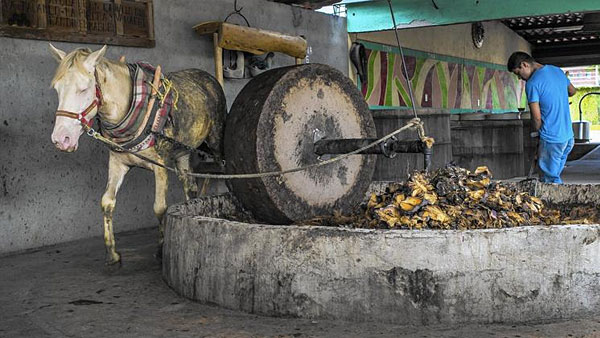
A worker operates a horse-pulled millstone to pulverize agave hearts that will be allowed to ferment and then distilled to make mezcal, at the Don Tacho distillery in Santiago Matatlan, Oaxaca, Mexico (Omar Torres/Getty Images)
Though mezcal can be made from more than 30 types of agave and tequila is made from only blue agave, both of these spirits are produced in basically the same way. But how the agave plants are milled — that is, crushed or pulverized — has an impact on the way either finished spirit will taste.
With both mezcal and tequila — and before fermentation and distillation — agave hearts are cooked and then milled using mallets, tahonas, roller mills or wood chippers.
Using wooden mallets is the most ancient way to break up fibrous agave hearts. Eduardo Javier Angeles Carreno, mezcal master of Oaxaca, Mexico's Sacapalabras and mezcal Lalocura, explains that with mallet crushing, "there's a physical cost, (but it) produces a more accurate expression of the terroir: the smell of the earth, the flowers, the atmosphere of the place where it's made."
Grinding with tahona is another centuries-old technique — a large, traditionally stone wheel is moved (by animal or machine) around an enclosed stone circle filled with cooked agave.
Mallets and, to a much greater extent, tahonas are used in the frequently unregulated, artisanal mezcal production facilities of Oaxaca.
An updated approach to crushing agave is by automated roller mill, which moves agave hearts through grinding wheels that separate the fibers. This is a much more efficient process than mallet and tahona. It's used for producing spirits in very large quantities. Such high-volume production is much more characteristic of tequila than it is of mezcal, which still tends to be made by relatively small producers.
Using a roller mill to macerate or shred the agave determines the flavors in the finished bottle. Whereas agave spirits made through the use of a tahona have earthier and more complex flavors, agave spirits made through the use of a roller mill have more citrus-y, herbaceous flavors.
Read the rest at
Related: What’s the Difference Between Mezcal and Tequila? (The Globe and Mail)
Related: Is Tequila the World’s Most Misunderstood Spirit? (Hong Kong Tatler)
Related: This Gold-Encrusted Tequila Bottle Costs as Much as Your First Salary (VinePair)
We invite you to add your charity or supporting organizations' news stories and coming events to PVAngels so we can share them with the world. Do it now!
Celebrate a Healthy Lifestyle
 From activities like hiking, swimming, bike riding and yoga, to restaurants offering healthy menus, Vallarta-Nayarit is the ideal place to continue - or start - your healthy lifestyle routine.
 Banderas Bay offers 34 miles of incomparable coastline in the states of Jalisco and Nayarit, and home to Puerto Vallarta and Riviera Nayarit's many great destinations.