
| The U.S.-Mexico War on Narcotics Takes Two Steps Back for Every Step Forward Luca Loggia - Global Americans | |
| go to original August 5, 2017 |
 |
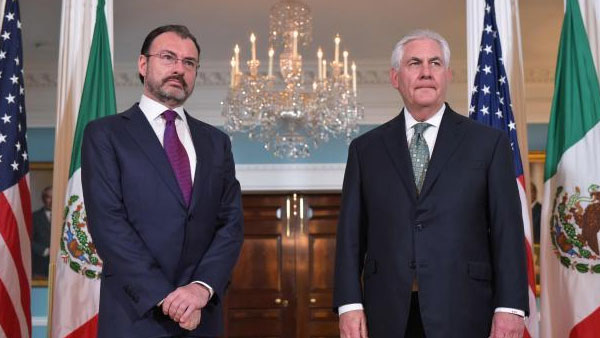
U.S. Secretary of State Rex Tillerson and Mexican Secretary for External Relations Luis Videgaray at bilateral meeting on security and trade in April (AFP)
The Rio Grande - long a symbol of connection between two increasingly interdependent partners on questions of trade and security - has recently come to symbolize the rift between the United States and Mexico. Despite President Trump’s threats over making Mexico pay for a border wall, his vitriolic rhetoric towards Mexican migrants, and the albatross of ongoing renegotiations of the North American Free Trade Agreement (NAFTA), the two countries have consistently managed to find common ground in their endeavor to weaken the influence of drug cartels - key contributors to both Mexico’s endemic levels of violence and the flow of narcotics into the U.S.
That personal misgivings between the current tenants of the White House and Los Pinos have taken a backseat to pragmatism on matters of narcotics is no coincidence. President Trump has repeatedly boasted about his “tough on crime” approach, appointing anti-drug hardliner Jeff Sessions as his Attorney General and justifying plans for a border wall on the grounds of diminishing U.S.-bound drug trafficking.
It’s no surprise, then, that cooperation with the U.S. has been an integral component of Mexico’s campaign against drug cartels since then-President Felipe Calderón signaled his country’s engagement in the war on narcotics in 2006. A year later the two countries signed on to the Mérida Initiative - a bilateral project calling for Mexican curtailment of organized crime and concomitant violence in exchange for greater U.S. efforts at reducing domestic demand for narcotics.
Under the Mérida Initiative, Congress has provided over $2.5 billion in aid to the Mexican government for narcotics detection resources, training of justice sector personnel, crop eradication efforts, and other anti-narcotic strategies aimed at reining in the movement of cartels on both sides of the Rio Grande.
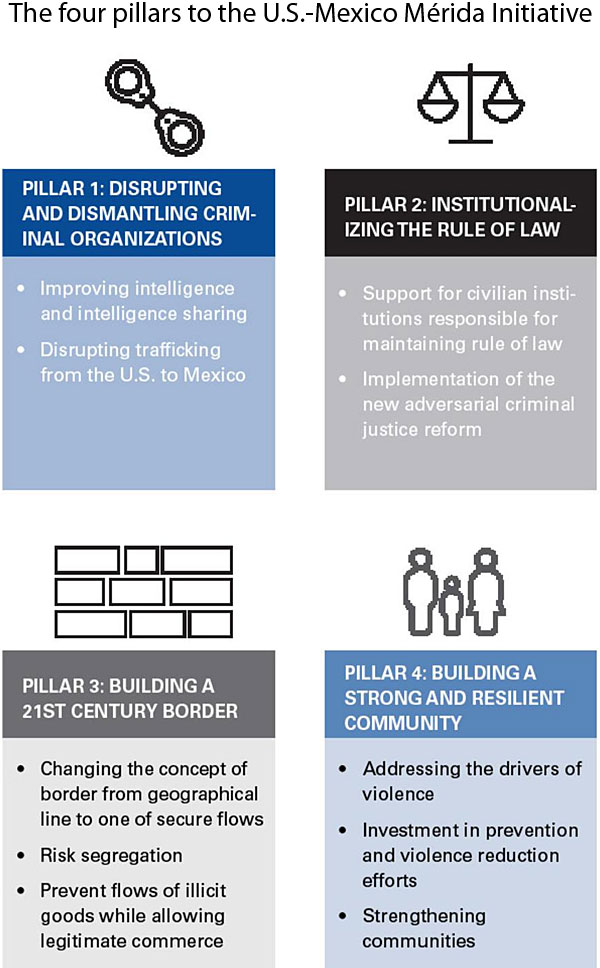
The Mexican national armed forces have emerged as major beneficiaries of the Initiative’s first pillar - disrupting the organizational capacity of drug cartels. Between 2008 and 2010, they received over $300 million in foreign military assistance. What this has meant for the military is compliance to the “kingpin strategy” - a policy intended to capture or liquidate mid-to-high level cartel operatives - commenced under Calderón and carried on in the Peña Nieto administration. This bilateral security strategy, favored since Mexico began its war on organized crime more than a decade ago, has had notable successes in gutting the Michoacán Family (MF) and the Knights Templar (KT) cartels. Even so, the two-way offensive to placate drug cartels achieved its most significant symbolic victory in January as Mexico extradited Sinaloa Cartel leader Joaquin ‘El Chapo’ Guzmán to the U.S. Symbolic achievements aside, however, there’s been little beyond acknowledgement from both Mexico City and Washington of the growing elephant in the room.
Despite a relative detente during Peña Nieto’s first two years in power, Mexico registered a 22 percent increase in homicides last year. The historic numbers from June 2017 mark a grim high watermark since the government began to release crime data in the 1990s. Further compounding the government’s unease, citizen security in Mexico has broken down despite massive government investment. In fact, under Calderón and Peña Nieto, state spending on public security has tripled. Moreover, Michoacán - the object of Mexican soldiers’ first operation in the drug war - has seen an uptick in violent crimes despite the state’s efforts to subdue the MF and its offshoot, the KT. In truth, rather than bringing about the conditions for peace, the decapitation strategy favored thus far by the U.S. and Mexican administrations has only given rise to greater competition from smaller-level groups in search of control.
President Peña Nieto’s woes have been compounded by his inability to act upon allegations linking soldiers to a host of human rights abuses against civilians. During his administration alone, Mexico’s National Human Rights Commission (CNDH) has received over 2000 complaints of abuse by the army. One of the most recent attacks came from Santiago Roel, the director of the citizen security organization Semáforo Delictivo, who’s gone as far as to blame the Initiative itself for the record levels of violent crime. Despite the barrage of critiques President Peña Nieto has faced from human rights organizations, the face of the Revolutionary Institutional Party (PRI) has shown defiance; labeling accusations against the military as “inadmissible and unacceptable” and deploying 900 soldiers in Sinaloa to enhance security. While supporters praise the president’s doggedness, critics of the long-running security approach, like Wilson Centre fellow David Shirk, have suggested greater emphasis be placed on tapping into youth potential through educational and employment opportunities.
In Washington, lawmakers on both sides of the aisle hoping for a dramatic change in posture are likely to be disappointed. Since arriving in office, President Trump has not only requested slashing funding to Mérida by almost 40 percent in the next budget. His administration has doubled down on the anti-drug and security approach to combatting drug cartels. Secretary of State Rex Tillerson made this clear at a meeting in May between U.S. and Mexican officials when he reaffirmed both states’ commitment “to disrupt and destroy the criminal organizations which threaten our citizens, our communities, and our country”.
With the developments in Washington - or lack thereof - U.S. lawmakers will likely be digging themselves in a bigger ditch.
Read the rest at Global Americans
We invite you to add your charity or supporting organizations' news stories and coming events to PVAngels so we can share them with the world. Do it now!
Celebrate a Healthy Lifestyle
 From activities like hiking, swimming, bike riding and yoga, to restaurants offering healthy menus, Vallarta-Nayarit is the ideal place to continue - or start - your healthy lifestyle routine.
 Banderas Bay offers 34 miles of incomparable coastline in the states of Jalisco and Nayarit, and home to Puerto Vallarta and Riviera Nayarit's many great destinations.