
| Lawful Mexican Immigrants Among the Least Likely to Become American Citizens Ana Gonzalez-Barrera - Pew Research Center | |
| go to original June 29, 2017 |
 |
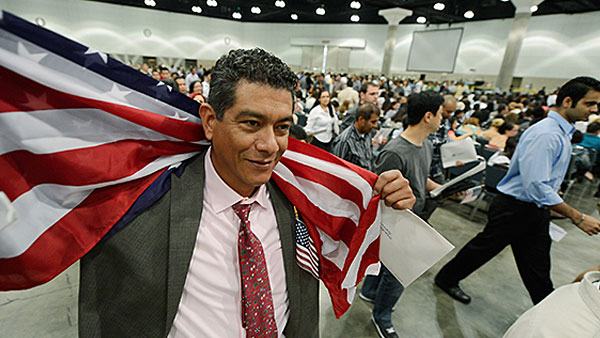
A Mexican-born man celebrates after taking the U.S. oath of citizenship in a naturalization ceremony at the Los Angeles Convention Center. (Kevork Djansezian/Getty Images)
 The overall percentage of lawful immigrants to the United States choosing to apply for and gaining citizenship is at its highest level in more than two decades. Yet in terms of naturalization rate, Mexicans – the single largest group of lawful immigrants by country of origin – lag well behind green-card holders eligible to apply from other parts of the globe.
Based on Pew Research Center estimates using the most recent U.S. Census Bureau data available, two-thirds (67%) of lawful immigrants eligible to apply for U.S. citizenship had applied for and obtained citizenship by 2015. This is the highest share since at least the mid-1990s. But among Mexican lawful immigrants eligible to apply, only 42% had applied for and obtained U.S. citizenship by 2015, a rate little changed since 2005 and one of the lowest among all immigrant groups when it comes to country of origin.
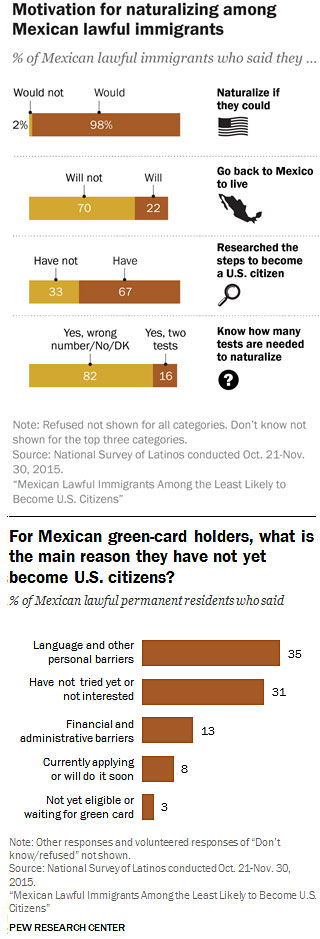
As part of a larger survey of Hispanic immigrants fielded in late 2015, Pew Research Center asked Mexican green-card holders why they had not yet become naturalized U.S. citizens. The most frequent reasons centered on inadequate English skills, lack of time or initiative, and the cost of the U.S. citizenship application. These appear to be significant barriers, as nearly all lawful immigrants from Mexico said they would like to become U.S. citizens someday.
Overall, 11.9 million of the nation’s 45 million immigrants in 2015 held lawful permanent residence (LPR) status – that is, they held “green cards,” according to Pew Research Center estimates. Of this number, most (9.3 million) had met the eligibility requirements – including length of residence – to apply for U.S. citizenship in 2015.1 Mexicans made up 37% of this group and constituted the single largest group of green-card holders without U.S. citizenship by country of origin.
In the United States, the citizenship, or naturalization, rate among all lawful immigrants steadily increased from 1995 to 2005, rising from 47% to 62%. Until about 2005, the naturalization rate among lawful immigrants from Mexico also increased steadily, but did so more rapidly (from 20% in 1995 to 38% in 2005), narrowing the gap between Mexicans and other immigrants. However, between 2005 and 2010, the naturalization rate of Mexican green-card holders leveled off, even as the rate for lawful permanent residents from other parts of the globe continued to rise. Only in the period from 2011 to 2015 did the rate of naturalization among eligible Mexican immigrants significantly increase again at a pace higher than that of other lawful U.S. immigrants – going from 38% to 42% among Mexicans, compared with a 2-percentage-point increase, from 72% to 74% among non-Mexican immigrants.
As of 2015, the naturalization rate for lawful Mexican immigrants trailed that of green-card holders from the Middle East by 42 percentage points (42% vs. 83%), and was 33 points behind green-card holders from Africa, 74% of whom had naturalized by 2015. Middle Eastern immigrants had the highest naturalization rate among all immigrant origin groups, while African immigrants saw the highest increase in naturalization rate in the last decade.
Early signs are that 2017 could see an increase in the rate of naturalization of lawful permanent residents.
Read the rest at Pew Research Center
We invite you to add your charity or supporting organizations' news stories and coming events to PVAngels so we can share them with the world. Do it now!
Celebrate a Healthy Lifestyle
 From activities like hiking, swimming, bike riding and yoga, to restaurants offering healthy menus, Vallarta-Nayarit is the ideal place to continue - or start - your healthy lifestyle routine.
 Banderas Bay offers 34 miles of incomparable coastline in the states of Jalisco and Nayarit, and home to Puerto Vallarta and Riviera Nayarit's many great destinations.