
| Latin American Laws on Access to Public Information Are Among the Best in the World, Experts Say Paola Nalvarte - Journalism in the Americas | |
| go to original June 19, 2017 |
 |
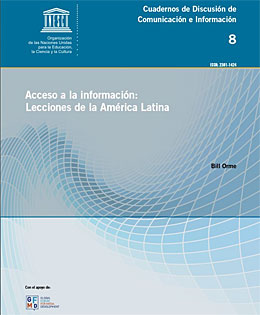 |
| Access to Information: Lessons from Latin America (PDF) |
More than 100 countries in the world have a law in their national legislation that allows access to public information. Latin America is the region with developing countries that has advanced most in this respect, even surpassing certain aspects of the laws of European Union countries, according to the recent Unesco report, "Access to Information: Lessons from Latin America.”
With the exception of Bolivia, Costa Rica, Cuba and Venezuela, most countries in Latin America have laws that guarantee access to official information. Even some Latin American laws are considered among the best in the world, according to the report, prepared by U.S. investigative journalist Bill Orme.
Orme interviewed three experts on freedom of information who led the implementation of the laws in Mexico, Chile and Brazil.
Jacqueline Peschard Mariscal, former director of the Federal Institute for Access to Information of Mexico (IFAI for its acronym in Spanish); Juan Pablo Olmedo, former president of the Transparency Council of Chile; and José Eduardo Elías Romão, Brazil's first Ombudsman, agreed that the implementation and social impact of the law is the most important objective.
For several countries in the region, one of their great challenges is to protect journalists from attacks and threats. It’s also to safeguard the freedom of the press and the daily access to public information so that they are not restricted, the former Latin American commissioners and defenders of freedom of information highlighted.
Since September 2015, United Nations member countries have unanimously adopted Agenda 2030, which establishes national and global development policy guidelines for the next 15 years.
Among these guidelines is the list of sustainable development objectives, which include ensuring public access to information and protection of fundamental freedoms, in accordance with national laws and international agreements.
In that sense, the study analyzes, in detail, Mexico’s law, which was adopted 15 years ago and is considered to be the model law worldwide; the one from Chile, which has been in effect for almost 10 years; and that of Brazil, which has just turned five-years-old.
The laws of Mexico, Chile and Brazil have common political origins, as they were approved as a deliberate rejection of the recent authoritarian past of those countries, and as a collective effort to build legal safeguards to prevent the return of undemocratic regimes, the report said.
Read the rest at Journalism in the Americas | Lea en Español
We invite you to add your charity or supporting organizations' news stories and coming events to PVAngels so we can share them with the world. Do it now!
Celebrate a Healthy Lifestyle
 From activities like hiking, swimming, bike riding and yoga, to restaurants offering healthy menus, Vallarta-Nayarit is the ideal place to continue - or start - your healthy lifestyle routine.
 Banderas Bay offers 34 miles of incomparable coastline in the states of Jalisco and Nayarit, and home to Puerto Vallarta and Riviera Nayarit's many great destinations.