
| Could Mexico Get Back Territory Lost to the US in the Treaty of Guadalupe Hidalgo? Enrique Krauze - The New York Times | |
| go to original April 7, 2017 |
 |
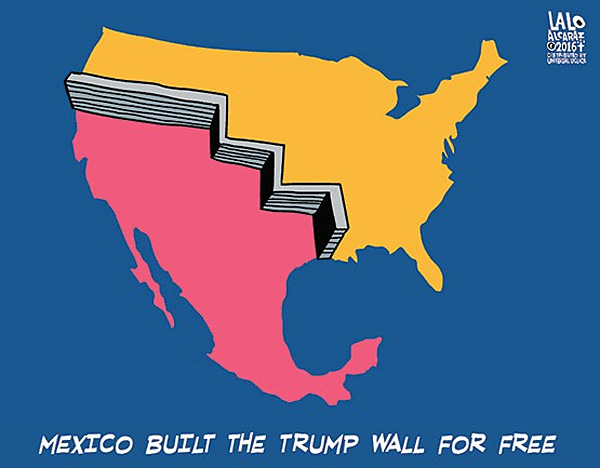
The United States invasion of Mexico in 1846 inflicted a painful wound that, in the 170 years that followed, turned into a scar. Donald Trump has torn it open again.
Among the many lies that he has constructed, none is more ridiculous than his attempt to contradict history by presenting the United States as a victim of Mexico, a country that supposedly steals jobs, imposes onerous treaties and sends its “bad hombres” across the border.
To confront this fake history, some Mexicans are proposing to remind Mr. Trump exactly what country was the first victim of American imperialism. They are calling for a lawsuit that would aim to nullify the Treaty of Guadalupe Hidalgo (signed on Feb. 2, 1848), in which Mexico — invaded by American soldiers, its capital occupied, its ports and customs stations seized — was forced to accept the American annexation of Texas and concede more than half the rest of Mexican territory, now including most of the states of Arizona, New Mexico and California.
This effort is being led by Cuauhtémoc Cárdenas, the elder statesman of the Mexican left. Mr. Cárdenas is convinced that the Mexican government — especially given the need to confront Mr. Trump’s aggression — has a solid legal case. In his opinion, the 1848 treaty violates essential international legal norms and a case can be brought before the International Court of Justice, proposing reparations and indemnification. And even if one admits the legal validity of much of the treaty, there are a number of crucial articles — such as those dealing with citizenship, property and the security of 100,000 Mexicans who remained on what became American territory — that have been ignored from the beginning.
Such an effort faces formidable obstacles, though. A former Mexican secretary of foreign relations, Bernardo Sepúlveda Amor, the leading Mexican expert in international law, believes — “much to his regret,” he said — that Mr. Cárdenas’s initiative is not feasible. “In previous times, wars of conquest did not find the same moral and legal condemnation that is nowadays part and parcel of our system of law,” he told me. The treaty would have to be challenged under the Vienna Convention on the Law of Treaties, “for which it must be shown that the state did not expressly agree that the treaty is a valid instrument or that, by reasons of its own conduct, that state must be considered as not having acquiesced to the validity of the treaty.”
But this is not the case with the Treaty of Guadalupe Hidalgo, which was signed with the agreement of both governments. “Additionally, the claim to annul the 1848 treaty must be submitted to the International Court of Justice to obtain a judgment on the matter,” Mr. Sepúlveda said. “But the United States does not recognize the compulsory jurisdiction of the court in contentious cases.”
Nonetheless, juridical reasoning is one thing, political reasoning another. If the present Peña Nieto government does not adopt Mr. Cárdenas’s project, an opposition candidate (of either the populist left or the nationalist right) could legitimately assume it as a banner for the presidential elections of July 2018. Such a new president could make that lawsuit a reality.
Read the rest at The New York Times
We invite you to add your charity or supporting organizations' news stories and coming events to PVAngels so we can share them with the world. Do it now!
Celebrate a Healthy Lifestyle
 From activities like hiking, swimming, bike riding and yoga, to restaurants offering healthy menus, Vallarta-Nayarit is the ideal place to continue - or start - your healthy lifestyle routine.
 Banderas Bay offers 34 miles of incomparable coastline in the states of Jalisco and Nayarit, and home to Puerto Vallarta and Riviera Nayarit's many great destinations.