
| In Mexico's Drug War, Military's Disqualification of Human Rights Complaints Is Ominous Jorge Javier Romero Vadillo - SinEmbargo | |
| go to original March 27, 2017 |
 |
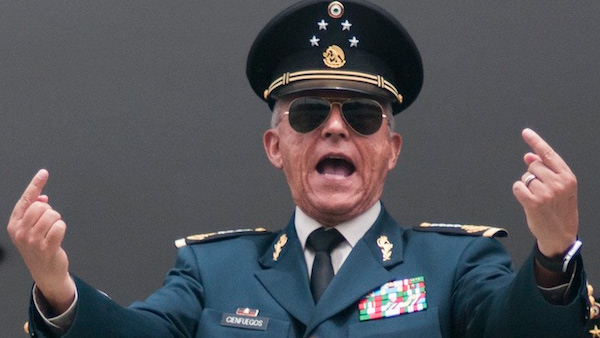
Salvador Cienfuegos Zepeda, Secretary of National Defense (Mientras Tanto en México)
Mexican armed forces are not accustomed to criticism. For decades, during the PRI regime's classical era, they were untouchable in the media. This was part of the pact that guaranteed their relative distance from the struggle for political power. In exchange for submission to civilian control, the army's upper ranks were able to hold onto control of important sources of income in various regions of the country, have direct representation in Congress and state governments, and protection from any scrutiny of their activities by society (not to mention the judiciary).
In the official discourse, the armed forces were an object of recognition and honor in every presidential annual report to Congress, where its patriotic service was praised. As soon as they were mentioned by the President, military leaders were enthusiastically applauded by those present in the legislative chamber, and they stood up with a salute to acknowledge the applause. More than an obligation, their acceptance of subordination to the regime's civilian order was seen as a concession that should be acknowledged every year from the podium when the president simulated being accountable to the nation.
Therefore, it is not surprising that the military would be sensitive to criticism of their performance in public security tasks. Its low tolerance not only reflects its lack of practice in accountability, which is natural in military organizations of authoritarian regimes like the Mexican one. It also reflects a sense of vulnerability caused by high exposure to public attention because of their widespread deployment over the past two decades [in the war against the drug cartels]. Members of the military feel exposed because civilian authorities have placed them on the front line of responsibility in activities for which they are neither constitutionally fit nor, according to their own accounts, trained.
Thus, the human rights director of the National Secretariat of Defense, General José Carlos Beltrán, held a press conference to disqualify questioning the army as slander and defamation. Generically, he rejected all criticism as libelous if it is not accompanied by a formal accusation, as if statistically-supported evidence, based on data from official sources, was not enough to draw attention and trigger alarms about the need to revise the deployment of the military as the main strategy of public security policy. When all critics are treated as mere opponents, all responsibility ends up being shirked.
Read the rest at Mexico Voices | Spanish original
Related: Mexico Government and the Drug War: The Military Is Not the Answer (Reforma)
Related: What Does the Trump Era Mean for Drug Policy in Latin America? (World Politics Review)
Related: Mexico, Columbia and the Anti-Drug Craze of the Trump Administration (Proceso)
Translated by Leslie Castillo Navia
Mexico Voices is a blogging endeavor aimed at raising the awareness of U.S. citizens regarding the destructive impact of the U.S. economic policy and the War on Drugs on Mexico - on its people, their economic and physical security and their human rights, on the nation’s dysfunctional justice system, and on the rule of law and Mexico’s fragile democracy. Visit the website at MexicoVoices.blogspot.mx
We invite you to add your charity or supporting organizations' news stories and coming events to PVAngels so we can share them with the world. Do it now!
Celebrate a Healthy Lifestyle
 From activities like hiking, swimming, bike riding and yoga, to restaurants offering healthy menus, Vallarta-Nayarit is the ideal place to continue - or start - your healthy lifestyle routine.
 Banderas Bay offers 34 miles of incomparable coastline in the states of Jalisco and Nayarit, and home to Puerto Vallarta and Riviera Nayarit's many great destinations.