
| Photography Project Urges Mexicans Never to Forget Crimes that Have Gone Unpunished Erin Gallagher - Global Voices | |
| go to original March 19, 2017 |
 |
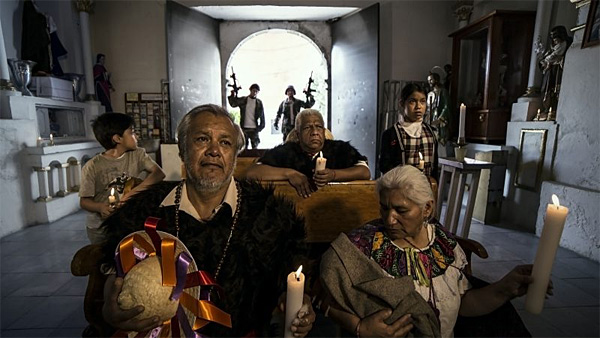
“Mientras Orabamos” (Pablo Tonatiuh Álvarez Reyes)
Please be warned that some of the images in this post, although staged, depict graphic violence.
Photographer Pablo Tonatiuh Álvarez Reyes has created “Sin Olvido” (Without Forgetting), a series of striking photomontages to highlight cases of unsolved crimes in Mexico.
Tonatiuh says he seeks to criticize the collective memory of Mexicans who easily forget crimes that go unpunished, many of them covered up by politicians. These injustices are often perpetrated against some of the most vulnerable people in Mexico.
The images are produced using a style of artistic presentation called Tablau vivant, French for “living picture.” The technique features staged subjects who are theatrically lit for dramatic effect, which creates a hyper-realistic aesthetic.
He has so far released seven out of the nine pieces from the Sin Olvido project on his Facebook fan page. In an interview with Global Voices, he explained the photomontages are not only art, but activism, and so he is timing the publication of each photo to have maximum impact.
Mientras Orabamos (While We Prayed)
The photomontage “Mientras Orabamos” (While We Prayed) at the start of this post represents the Acteal massacre in which paramilitaries killed 45 people, including women and children, who were attending a local prayer meeting in the small village of Acteal in the Mexican state of Chiapas, on December 22, 1997. The slaughter took place amidst the armed conflict between the state and the leftist militant group known as the Zapatista Army of National Liberation following the implementation in 1994 of the “Plan de Campaña Chiapas” – a counter-insurgency operation intended to infiltrate Zapatista-influenced zones with paramilitaries to prevent the spread of the ideology.
In our interview with Tonatiuh, he explained the importance of highlighting the indigenous victims of this massacre:
“Mientras Orabamos” (While We Prayed) speaks to the massacre that occurred in the small town, Acteal, in the Chiapas highlands. A group of Tzotzil indigenous peoples were praying in a Pentecostal Christian church when a group of paramilitaries arrived and opened fire. Forty-five people were killed including women and children. A paramilitary group opposed to the Zapatista Army of National Liberation was blamed for having committed the crime, although it was never clear who was responsible, but the most obvious answer is that the federal government wanted to teach the guerrillas in Chiapas a lesson.
To speak of this event gives voice to a little-known group in the country: the indigenous peoples.
El Silbato de Mancera (Mancera's Whistle)
El “Silbato de Mancera” (Mancera's Whistle) refers to a policy implemented by the government of Mexico City to prevent violence against women by giving them an “anti-assault” whistle to use if they are attacked in the street. Named for Miguel Ángel Mancera, the current mayor of Mexico City, the pink whistles were criticized as a superficial and ineffective solution against the widespread violence against women in Mexico.
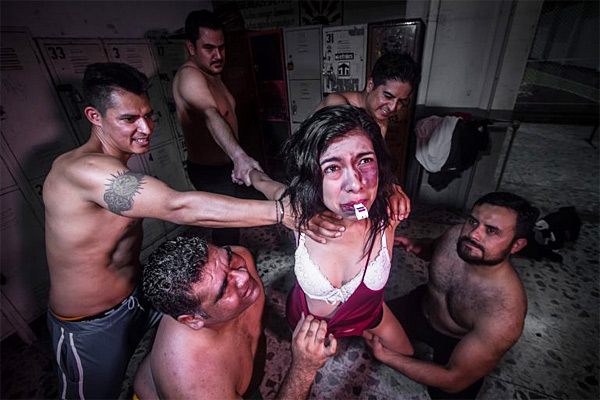
“El Silbato de Mancera” (Mancera's Whistle) (Pablo Tonatiuh Álvarez Reyes)
Violence towards women cannot be resolved by separating them in subway cars, recommending that they wear long skirts, or giving them pink whistles to call for help. Violence is fought through education, when one person understands the other, when one is respected, when one is known to another. Palliative measures to solve serious and profound problems only highlight the indifference to the subject, and worse, demonstrate that instead of being a solution, they are themselves part of the problem. – Pablo Tonatiuh Álvarez Reyes
Peñabot
“Peñabot” is an image criticizing the use of public resources to generate digital propaganda favorable to the government of President Enrique Peña Nieto. Peñabot is the popular name given to automated bots and trolls in Mexican social media that are used to overpower trending topics, which are mostly critical of the government, manipulate public opinion and harass users.

“Peñabot” (Pablo Tonatiuh Álvarez Reyes)
According to Dr. Ernesto Villanueva, academic and researcher at the National Autonomous University of Mexico's Legal Research Institute, the usage of peñabots violates Articles 6 and 134 of the Mexican Constitution and could cost an estimated 80 million pesos per month (approximately 4 million US dollars).
Hasta el Fin del Mundo (Until the End of the World)
This image refers to a tragic 2009 fire at the Guardería ABC, a daycare center in Sonora state in northern Mexico. The blaze took the lives of 49 children and left more than 70 with respiratory problems and other permanent conditions. There were suspicions that the fire, which began in a neighboring warehouse that housed the archives of the Sonora state treasury’s Department of Vehicular Control, was intentionally set.
The ABC daycare was federally funded by Mexico's Social Security Institute, but it was privately operated. Several safety rules had been violated including a lack of fire extinguishers, non-functioning smoke alarms and inadequate safety exits.
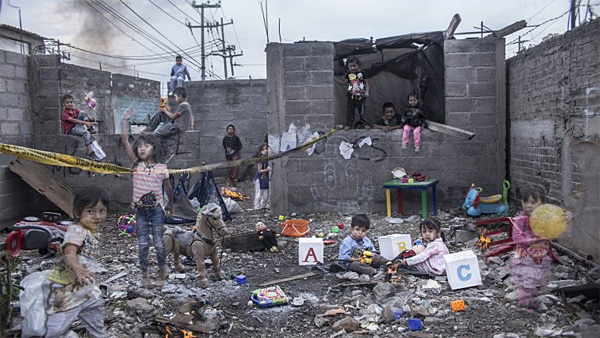
“Hasta el Fin del Mundo” (Until the End of the World) (Pablo Tonatiuh Álvarez Reyes)
An investigation took place afterwards to determine the cause of the fire and who was responsible. It implicated several high-level officials, like Juan Molinar Horcasitas — one of former President Felipe Calderon’s closest collaborators — as well as the administrators and owners of the daycare, including a cousin of Calderón’s wife. Some state officials resigned in the aftermath of the incident, but were not prosecuted. The only person arrested for the daycare fire was released from jail in January 2014.
In 2016, Danissa López Arvizu, the mother of one of the victims and a former teacher at the ABC daycare, explained to El Universal newspaper the pain caused by the lack of justice:
Every day I remember it more, the pain will always be there, will someone go to jail? Maybe, but what about my son? He will never be with his brothers and I. Who will pay for his death and the deaths of the other 48 children and the other 70 who were injured? The passage of time does not help me, on the contrary it gets worse with his absence. I need my child and he will always be in my thoughts, I would have liked him to live until the end of the world.
Las Edecanes (The Aides)

“Las Edecanes” (The Aides) (Pablo Tonatiuh Álvarez Reyes)
Tonatiuh explained the story behind “Las Edecanes”:
When the team of journalist Carmen Aristegui discovered the prostitution network headed by Gutierrez de Torre of the PRI political party of Mexico City, many felt a great satisfaction to see how journalism had achieved what our corrupt authorities in our country could not: unmask how the political power in our country turns women into prostitutes. Sadly, the feeling didn’t last long, and De la Torre was exonerated and walks through life as if nothing had happened. That's why I decided to make this photo, so no one forgets what he did, so that we will not forget what the PRI represents in our country, and to record that the power of many politicians is founded on limitless impunity.
May this photo serve to perpetuate the indignation that so quickly dissolves over time in our country.
La Construcción del Nuevo Aeropuerto (The Construction of the New Airport)
San Salvador Atenco is a town in Mexico state known for its resistance movement against the construction of a new airport in 2002. Citizens organized and formed the Frente del Pueblo en Defensa de La Tierra (the People's Front in Defense of the Land) and resisted the airport construction, ultimately causing the government to abandon the project. Their successful resistance earned the citizens of San Salvador Atenco nationwide recognition.
Several years later, on May 3, 2006, police blocked 60 flower vendors from setting up their stands in the Texcoco market, not far from San Salvador Atenco. Those who resisted were beaten and arrested. The flower vendors called on their neighbors for help and the citizens of San Salvador Atenco responded by blocking a local highway. What transpired next would come to be known as the Atenco Massacre. A massive police operation that first violently repressed and lifted the highway blockade on May 3, then escalated on May 4 when police raided the homes of private citizens, arrested and beat people arbitrarily and terrorized the town. The media portrayed the siege as a justifiable police action against a small group of violent, machete-wielding agitators.
Two teenagers died and more than 200 people were detained including women, minors, journalists, human rights observers and several foreigners. Some 26 of the women who were detained were subjected to monstrous sexual torture at the hands of police while they were being transferred to prison. The trip which should have only taken about 2 hours turned into a 6-hour nightmare. Testimonies of 11 of the 26 women were included in a complaint filed by the Inter-American Commission on Human Rights (CIDH) against the Mexican state. The complaint detailed how the women were stripped, humiliated, forced to perform oral sex and raped by police.
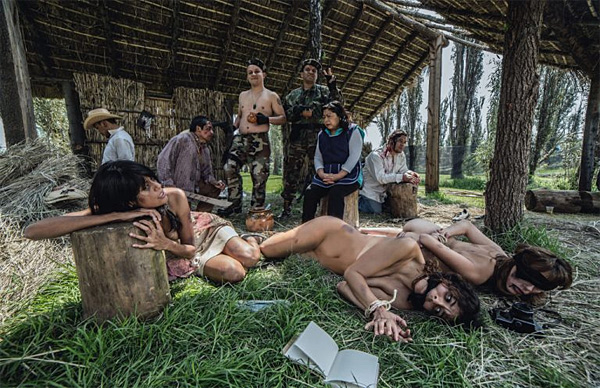
“La Construcción del Nuevo Aeropuerto” (The Construction of the New Airport) (Pablo Tonatiuh Álvarez Reyes)
Of the 16 police officers who were prosecuted for these heinous abuses, 15 were released without charges. One state police officer was sentenced to three years in prison for “libidinous acts,” but ended up serving no jail time because his charge was categorized as a non-serious crime under the Mexican Penal Code; his sentence was changed to a fine of $8,427 pesos (approximately $420 US dollars).
The then governor of Mexico State, Enrique Peña Nieto, appeared on national news and reassured the public that he had ordered the police action and that it was necessary to restore peace and order. He also publicly stated there would be further investigation but that it was possible the women were “fabricating accusations.” Peña Nieto later went on to become the current president of Mexico.
Several of the women who were assaulted by police in Atenco weren't from Mexico. María Sastres from Spain testified to Amnesty International:
They did everything to us, we saw all of the blood on the ground and heard people screaming in pain but since our faces were covered we couldn’t see who they were. I do not want to go into many details about the sexual assaults, but they took off our clothes, they ripped them off, the hands of many policemen passed over us and I prefer to not say any more…
No Nos Olviden (Don't Forget Us)
Two years have passed since a group of students from the Raúl Isidro Burgos Rural Teachers’ College – with its headquarters in Ayotzinapa, in the western Mexican state of Guerrero – were deprived of their freedom by local police and then allegedly handed over to the Guerreros Unidos armed group, never to be heard from again. The Ayotzinapa case, as this tragic series of events is known, remains unpunished, and the families of the 43 students still don't know what happened to their loved ones.
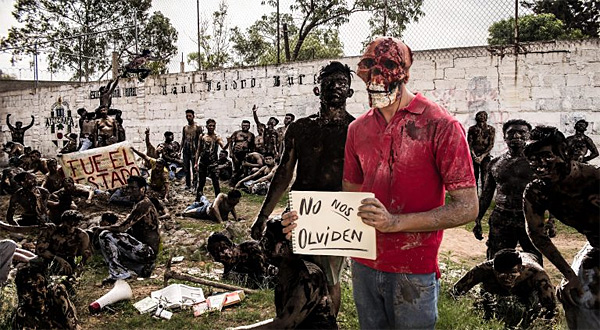
“No Nos Olviden” (Don't Forget Us) (Pablo Tonatiuh Álvarez Reyes)
‘All new struggles are also the old ones’
Tonatiuh reflected on his work in an interview with revistakulte.com:
People no longer want to remember or think about these cases, because maybe they do not see any case. So this project tells us that we should not forget what happened to us, like Atenco, the News Divine disco tragedy, which was perhaps more local, but all such events are important when they have no closure, when those responsible have not been punished. We must continue to struggle because all new struggles are also the old ones, they are the same.
You can follow Tonatiuh's work on Facebook at Pablo A. Tonatiuh Fotografía.
See the original at Global Voices
We invite you to add your charity or supporting organizations' news stories and coming events to PVAngels so we can share them with the world. Do it now!
Celebrate a Healthy Lifestyle
 From activities like hiking, swimming, bike riding and yoga, to restaurants offering healthy menus, Vallarta-Nayarit is the ideal place to continue - or start - your healthy lifestyle routine.
 Banderas Bay offers 34 miles of incomparable coastline in the states of Jalisco and Nayarit, and home to Puerto Vallarta and Riviera Nayarit's many great destinations.