
| Unemployment and the Informal Economy Are Key Challenges for Latin American Women Jose Manuel Salazar-Xirinachs - Inter Press Service | |
| go to original March 7, 2017 |
 |
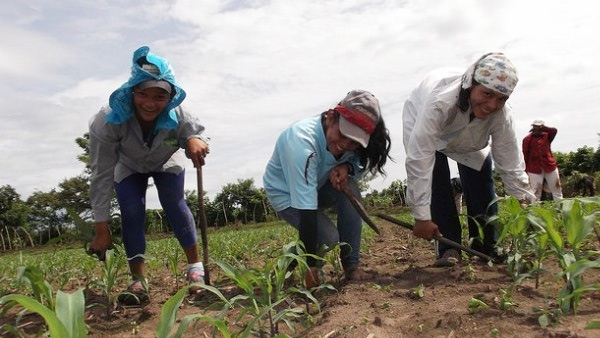
Rural workers in the Bajo Lempa region of El Salvador (Edgardo Ayala/IPS)
The participation of women in the labor market in Latin America and the Caribbean has steadily grown over the last few decades. But in 2017, as unemployment and informal work are on the rise, there is a continued need to push hard for gender equality in order to create more and better employment for the 255 million women of working age in this region.
Almost half of these women, 126 million, are already part of the labor force – a very important achievement that took many years to reach. Once more, however, it must be stressed that we cannot let down our guard.
Over the past year, as the wave of slow growth and in some cases of economic contraction which struck the region impacted on the labor market, generating a sharp rise in unemployment and also a decline in the quality of employment with respect to some indicators, it has become evident that this situation affects women to a larger extent.
The regional average unemployment rate for women shot up to levels not seen for over a decade in Latin America and the Caribbean, to 9.8 per cent – on the brink of two digits. If projections of slow economic growth for this year prove correct, the average rate could climb above 10 per cent in 2017.
The unemployment rate for women grew 1.6 percentage points, compared to 1.3 percentage points for men. Of the five million people who joined the ranks of the unemployed, 2.3 million were women. This means that about 12 million women are actively looking for work, without success.
The participation of women in the labor force has continued to expand over the last year. At a national level (rural+urban), women’s participation has gone from 49.3 per cent to 49.7 per cent. An increase is always good news. However, it still remains well below the participation of men, which is 74.6 per cent.
The downside was that the demand for labor fell from 45.2 to 44.9 per cent in the case of women. It also dropped in the case of men, although the level remains much higher, at 69.3 per cent.
The latest ILO (International Labor Organization) Labor Overview of Latin America and the Caribbean also noted that the decline in economic activity has been reflected in a drop in the number of wage-earners, a rise in the number of self-employed workers, and a decrease in formal sector wages, all of which are signs of an increase in labor informality.
The most recent estimates available regarding informality among women indicate that almost half of the female labor force works under these conditions, which generally mean labor instability, low incomes, and a lack of protection and rights.
Read the rest at Inter Press Service | En español
Related: The Labor Market Is the Key to Equality for Women in Latin America (Inter Press Service)
IPS is an international communication institution with a global news agency at its core, raising the voices of the South and civil society on issues of development, globalization, human rights and the environment. Check out the website at IPSNews.net
We invite you to add your charity or supporting organizations' news stories and coming events to PVAngels so we can share them with the world. Do it now!
Celebrate a Healthy Lifestyle
 From activities like hiking, swimming, bike riding and yoga, to restaurants offering healthy menus, Vallarta-Nayarit is the ideal place to continue - or start - your healthy lifestyle routine.
 Banderas Bay offers 34 miles of incomparable coastline in the states of Jalisco and Nayarit, and home to Puerto Vallarta and Riviera Nayarit's many great destinations.