
| For Indigenous, Fish Mean Much More Than Just Food Yoshitaka Ota and Andres Cisneros-Montemayor - The Conversation | |
| go to original January 30, 2017 |
 |
Along the arid coastline of northwestern Mexico, indigenous Seri communities, who first resisted Spanish rule and then Mexican extermination efforts, eventually gained formal titles over a small part of their ancestral coastal and marine territories. The ocean has always sustained their livelihood, but now they must contend with outside competition over declining fish resources.
This is a familiar story for almost 30 million coastal indigenous peoples around the world from the Arctic to the South Pacific. But until recently no one had ever quantified how intensively they relied on seafood, or its importance for their existence as distinct peoples.
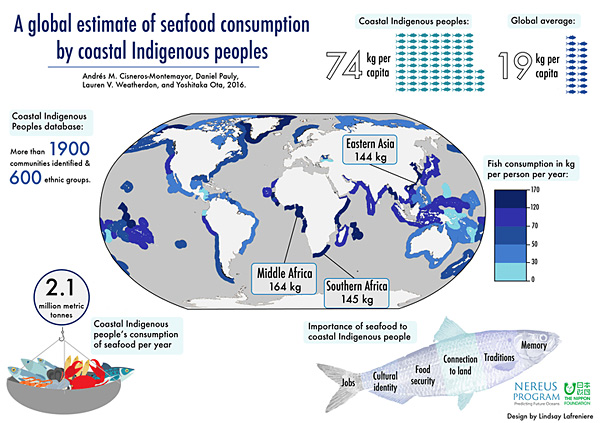
To fill this gap, we developed a global database of more than 1,900 indigenous communities, including 600 unique groups. Our study found that coastal indigenous peoples eat nearly four times more seafood per capita than the global average, and about 15 times more per capita than nonindigenous peoples in their countries.
Seafood is crucially important to these communities – but it provides them with more than vital protein and nutrients. It also plays a role in ceremonial traditions, creating important ties between families and individuals and embodying their symbolic ties to the environment.
The practice of catching fish affirms their worldviews and puts them into action in nature. These relationships and values cannot be reflected in a number, but quantifying the dietary importance of seafood for these communities can help us understand the importance of indigenous fisheries and relationships to the oceans on a global scale.
...Once we had developed our database, we estimated how much seafood people in these communities consumed, using sources such as public health and fisheries catch data. Where seafood consumption data for a community were not available, we estimated it by using averages for people from nearby indigenous communities, often belonging to the same group.
We estimate that 27 million coastal indigenous peoples consume 2.1 million metric tonnes of seafood per year. Compared to the global average of 19 kilograms (41 pounds) of seafood per person, these individuals consume 74 kilograms (163 pounds). Although they are becoming increasingly integrated into global food systems, coastal indigenous communities with cultural ties to the ocean on average eat 15 times more seafood than nonindigenous people in the same country.
This number suggests how important seafood is for coastal indigenous people’s food security. But we also must consider their “food sovereignty,” which implies not only having enough food, but being able to choose what you eat.
Read the rest at The Conversation
We invite you to add your charity or supporting organizations' news stories and coming events to PVAngels so we can share them with the world. Do it now!
Celebrate a Healthy Lifestyle
 From activities like hiking, swimming, bike riding and yoga, to restaurants offering healthy menus, Vallarta-Nayarit is the ideal place to continue - or start - your healthy lifestyle routine.
 Banderas Bay offers 34 miles of incomparable coastline in the states of Jalisco and Nayarit, and home to Puerto Vallarta and Riviera Nayarit's many great destinations.