
| Environmental Grassroots Protest: What Does It Mean to Resist and Defend Mexican Territory? Alice Poma and Tommaso Gravante - openDemocracy | |
| go to original December 25, 2016 |
 |
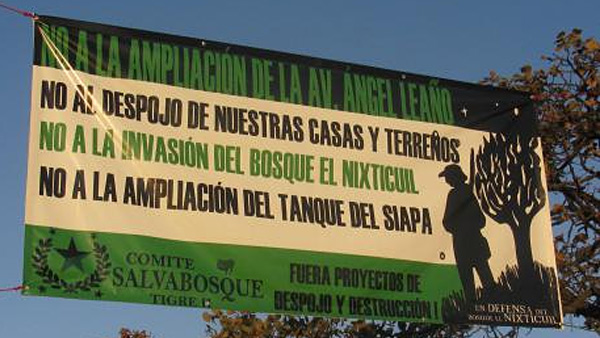
Mexico is going through a violent and repressive period not only because of the well-known assassination of six people and the disappearance of forty-three students at the rural school of Ayotzinapa in the state of Guerrero in September 2014, but also due to regular attacks on activists, journalists, women and citizens.
A report by the Mexican Environmental Rights Center (CEMDA) shows that 109 environmental activists suffered violence between May 2014 to June 2015 and 4 were killed in 2015. Moreover, from June 2014 to the end of May 2015, the following incidents have been recorded: 459 arbitrary arrests; 330 cases of attacks, threats, harassment; 224 people denied freedom for political reasons; 459 documented cases of torture; 47 extrajudicial executions (ACUDDEH, Comité Cerezo México and Campaña Nacional Contra la Desaparición Forzada, 2015).
Despite this repressive context where activism has become a high-risk activity, many experiences of resistance and struggles have flourished in Mexico. Among them, more than 420 environmental conflicts involve indigenous communities, rural villages and urban collectives that confront the state and companies to defend their territory and their right to live where they do.
When those who live in the threatened territories have to move to other places because of dams, airports, highways or wind farms, thousands are obliged to move and the environment can be degraded to a point which threatens the health and quality of life of the inhabitants of whole regions, such as in the El Salto and Juanacatlán municipalities in Jalisco. In this case, contamination of the Santiago River is killing inhabitants in the area, as exposed and denounced by the Un Salto de Vida collective (USV).
In this repressive context, environmental activism is growing. It is sustained by self-organized groups, which in many cases receive death threats, intimidation and other kinds of physical or psychological threats. What is it like to resist and defend the territory in such a repressive context? How can those involved avoid burnout? These questions can only be answered by analyzing the all-important emotional dimension of protest.
...Despite repression and powerlessness, these people keep resisting and creating alternatives. For those whom we interviewed, resisting and defending the territory nowadays in Mexico means that you are at war with the state and with financial capital (Poma and Gravante, 2015). In this war, those who are politically engaged and economically interested in the use and exploitation of the land work together with their allies (which includes some NGOs) to make themselves powerful enemies that can use fear as a strategy to break resistance. They also routinely stigmatise and criminalise the political activities of the groups and their members. On the exploited side, it is a minority of inhabitants do not allow the destruction of their territories, like the members of USV, CS and GER and their allies.
In addition to the activities geared at denouncing and preventing the destruction of their territories, these groups also have to manage their fear and other powerful emotions such as powerlessness, frustration, and strain. They need to suppress anger and hate, which if expressed can only provoke repression and violence from their enemies, and finally, as if this were not enough, they cannot lose hope and must keep resisting and creating alternatives.
Emotional work is as important as political and organizational activities, since it allows groups to counteract the fear of repression, channel anger towards their enemies, transform exhausting emotions into joy, and attempt not to be overcome by despair.
Read the rest at openDemocracy
Related: Community Rights: A Key to Conservation in Central America (Mongabay)
Related: Not Just North Dakota: Here Are 10 More States Where Activists Are Fighting Pipeline Projects (AlterNet)
Photo: Salvabosque
We invite you to add your charity or supporting organizations' news stories and coming events to PVAngels so we can share them with the world. Do it now!
Celebrate a Healthy Lifestyle
 From activities like hiking, swimming, bike riding and yoga, to restaurants offering healthy menus, Vallarta-Nayarit is the ideal place to continue - or start - your healthy lifestyle routine.
 Banderas Bay offers 34 miles of incomparable coastline in the states of Jalisco and Nayarit, and home to Puerto Vallarta and Riviera Nayarit's many great destinations.