
| Crossing the Darien Gap: A Journey Through the Heart of Darkness on the Way to America Kate Linthicum - The Los Angeles Times | |
| go to original December 22, 2016 |
 |
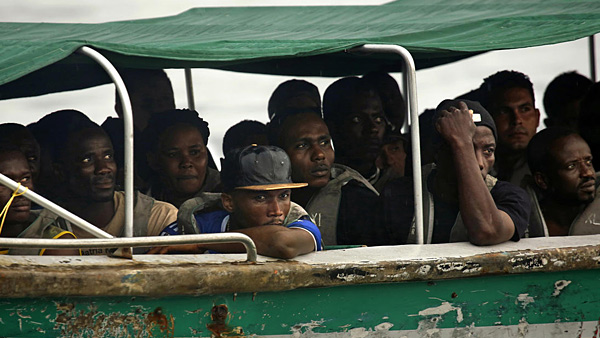
Every day hundreds of migrants from Cuba, Haiti and parts of Asia and Africa are attempting to cross the border from Colombia to Panama in the hopes of making it to the U.S. (Carolyn Cole)
The day began with a crack of lightning over Turbo, a Colombian port city built along a murky, trash-strewn bay.
Once the site of gun battles between leftist guerrillas and paramilitary groups, the city’s narrow streets now swirled with all types of commerce: Shirtless men hauled timber to the docks. Women hawked freshly gutted fish. And smugglers offered their services to migrants from all over the world on their way to the United States.
“Every day they come,” said Emelides Muñoz Meza, a local official who has found himself consulting maps of the world to understand where some of the thousands of foreigners making their way through his city have journeyed from.
“Eritrea? I didn’t even know this country existed,” Muñoz said.
The flow of migrants arriving in Colombia without visas has increased dramatically over the last three years. Some 9,500 of them transited the country in the first half of 2016, more than double last year’s levels and four times the number detained in 2014.
They are part of an unprecedented wave of global migration that has seen millions of refugees descend on Europe, fleeing poverty, persecution and war. Now, with migrant ships sinking in the Mediterranean and violent attacks in Europe, a rapidly growing number of migrants from Haiti, Cuba, Asia, Africa and the Middle East are making journeys of unimaginable difficulty up through South and Central America — dreaming of setting foot one day in the United States.

With a population of 163,000, Turbo is Colombia’s last major outpost of civilization before the border with Panama. Migrants come here to gather supplies and rest up before boarding boats across the gulf to a tiny Colombian border town where they begin their hike through the dense jungle that straddles the Panamanian frontier.
In recent years, Turbo has become a kind of 21st century Casablanca, the Moroccan town where European refugees fleeing Hitler waited for transport to the U.S. seven decades ago.
Read the rest at The Los Angeles Times
We invite you to add your charity or supporting organizations' news stories and coming events to PVAngels so we can share them with the world. Do it now!
Celebrate a Healthy Lifestyle
 From activities like hiking, swimming, bike riding and yoga, to restaurants offering healthy menus, Vallarta-Nayarit is the ideal place to continue - or start - your healthy lifestyle routine.
 Banderas Bay offers 34 miles of incomparable coastline in the states of Jalisco and Nayarit, and home to Puerto Vallarta and Riviera Nayarit's many great destinations.