
| Mexico's Migration Policy Is, De Facto, One of Detention Without Exception Joselin Barja - Animal Politico | |
| go to original December 14, 2016 |
 |
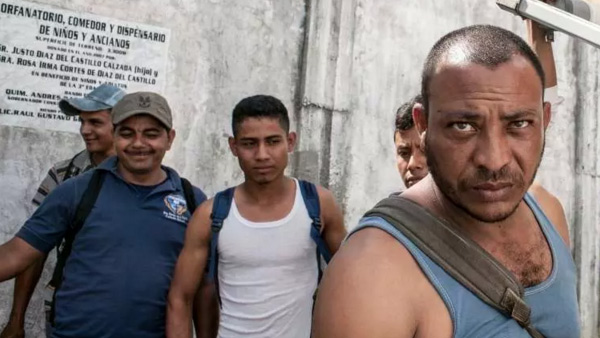
The International Committee of the Red Cross (ICRC) provides medical care to the migrants seeking safe-haven at a series of shelters located along heavily trafficked migration routes. (MSNBC)
In the last fifteen years, there have been 2,126,666 occurrences of expulsion of foreigners from our country. This retrospective look starts with the year 2000, the historic year in which Mexico consolidated its international image as a country of democratic alternation of the party in power, having achieved a change of governing party after 70 uninterrupted years of PRI [Party of the Institutional Revolution] governments.
The number 2,126,666 may seem relatively large or small, depending on how you look at it. If we think about the geographical area of a country and its population, such as Gambia or Slovenia that are home to 2,089,000 and 2,068,000 inhabitants respectively, we realize the implications of a migrant expulsion of such magnitude.
What happened in Mexico in the past decade and a half, a country on the path to democracy, such that migrant detention was established as the rule and not as an exception?
Throughout these years, we have witnessed important advances in migration policy, some of them positioning Mexico as an innovative country in Latin America for the development of its policy framework. In 2000, for example, there was no specific law for refugees, irregular migrant entrance was considered a crime and humanitarian aid [to undocumented migrants] was also an object of criminal prosecution. The penalties could range from 6 months to 5 years in prison. In 2008, the reform and repeal of several provisions of the General Population Law managed to legally decriminalize irregular migration, but [did not address] immigration detention.
We now have an Immigration Law and a Law on Refugees, Complementary Protection and Political Asylum. The Constitution has been reformed to focus on human rights, which had long been needed, and recently a General Law on the Rights of Children and Adolescents was published incorporating a chapter on migrant youth and the urgency of their protection for the best interests of the children.
However, in eight publications regarding monitoring carried out [by Without Borders] over these fifteen years in the migrant detention centers, called Migratory Stations, the observations are conclusive regarding promoting the correction of urgent aspects in support of migrants’ rights.
Read the rest at Mexico Voices | Español
Translated by Amanda Coe
Mexico Voices is a blogging endeavor aimed at raising the awareness of U.S. citizens regarding the destructive impact of the U.S. economic policy and the War on Drugs on Mexico - on its people, their economic and physical security and their human rights, on the nation’s dysfunctional justice system, and on the rule of law and Mexico’s fragile democracy. Visit the website at MexicoVoices.blogspot.mx
We invite you to add your charity or supporting organizations' news stories and coming events to PVAngels so we can share them with the world. Do it now!
Celebrate a Healthy Lifestyle
 From activities like hiking, swimming, bike riding and yoga, to restaurants offering healthy menus, Vallarta-Nayarit is the ideal place to continue - or start - your healthy lifestyle routine.
 Banderas Bay offers 34 miles of incomparable coastline in the states of Jalisco and Nayarit, and home to Puerto Vallarta and Riviera Nayarit's many great destinations.