
| How Forensic Anthropologists Are Helping Families of Mexico's Disappeared Seek Justice Lizzie Wade - AAAS | |
| go to original December 14, 2016 |
 |
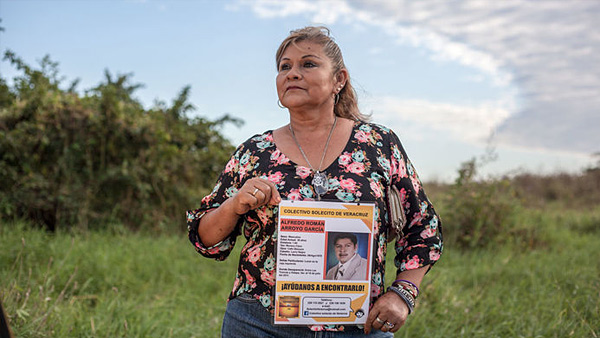
Celia García Velázquez has spent 5 years searching for her son Alfredo, who disappeared in Veracruz state. She has helped excavate the largest clandestine grave found in Mexico. (Félix Márquez)
Many here are mothers looking for their sons. Others are searching for brothers or cousins; one woman seeks six loved ones. They are part of the Solecito collective, a group of more than 100 people searching for the disappeared. And they are getting help from a new source: forensic anthropologists.
Veracruz, like many states in Mexico, is experiencing an epidemic of disappearances. Since the beginning of the drug war in 2006, more than 28,000 people have gone missing across the country, according to Mexico’s National Registry of Missing or Disappeared Persons. (That is likely an underestimate, as many disappearances go unreported because families fear retaliation.) Some are kidnapped by drug cartels and either killed or forced into labor or human trafficking. Human Rights Watch, a nonprofit based in New York City, says that many others are abducted by the police and military, and that the government does little to investigate. The 15 people in the classroom this weekend have come for help searching for their disappeared.
At the front of the classroom is anthropologist Roxana Enríquez Farias, who in 2013 founded a nonprofit organization called the Mexican Forensic Anthropology Team (EMAF) based in Mexico City. EMAF anthropologists often serve as expert witnesses, evaluating state investigations of disappearances. But on this November weekend, Enríquez Farias is explaining to the families themselves the steps of a search for the disappeared, and how to use their amateur searches to pressure the authorities into action. “We want to build the base [of knowledge] that will support their right to truth and justice,” Enríquez Farias explains.
“Until a few years ago, we scientists didn’t think about the families [of victims],” says Lorena Valencia Caballero, a forensic anthropologist at the National Autonomous University of Mexico in Mexico City who is not part of the group. But as the disappearances mounted into a humanitarian crisis, EMAF’s work became “exceedingly necessary,” she says. “It now falls to anthropologists to help the families understand how we determine age, what are the stage[s] of decomposition, how do organized crime groups behave - a thousand things they should never have had to learn.”
“It’s a brilliant strategy” when authorities are not sensitive to families’ needs, says forensic anthropologist Nicholas Márquez-Grant of Cranfield University in the United Kingdom. When he met families of the disappeared in Mexico this fall, “I could see that many relatives were completely lost.” He hopes EMAF’s model can be replicated in other countries, such as Iraq, where families are left by the wayside in disappearance investigations.
...Who vanishes: Disappearances are most common in states along the U.S.-Mexico border and in central Mexico. Teenage girls and young men are at the highest risk. Some are killed and others are conscripted into forced labor and human trafficking.

(Graphics) G. Grullón/Science; (Data) Mexico's National Registry of Missing or Disappeared Persons
Read the rest at AAAS | Español
We invite you to add your charity or supporting organizations' news stories and coming events to PVAngels so we can share them with the world. Do it now!
Celebrate a Healthy Lifestyle
 From activities like hiking, swimming, bike riding and yoga, to restaurants offering healthy menus, Vallarta-Nayarit is the ideal place to continue - or start - your healthy lifestyle routine.
 Banderas Bay offers 34 miles of incomparable coastline in the states of Jalisco and Nayarit, and home to Puerto Vallarta and Riviera Nayarit's many great destinations.