
| Keeping the Nahuatl Language of the Aztecs Alive Gabriel San Roman - OC Weekly | |
| go to original December 1, 2016 |
 |
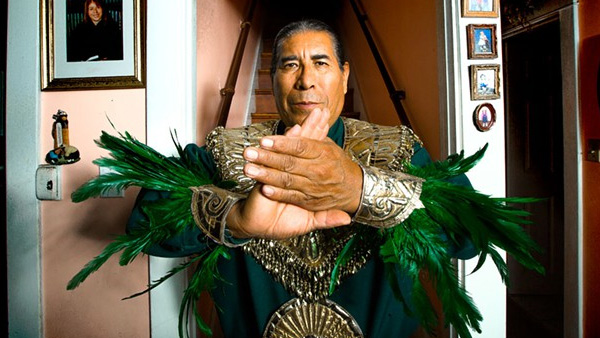
For the past 20 years, Davíd Vázquez has taught tens of thousands of students at community centers, universities and churches across Southern California (Rockography)
The word "Nahuatl" translates as "clear speech." It belongs to the Uto-Azteca linguistic group, which includes the languages of most of the Southwestern Indian tribes, lending credence to the Mexica founding myth that their homeland of Aztlán was north of the U.S.-Mexico border. Early speakers first migrated into central Mexico around the 7th century, following the decline of the Teotihuacan Empire. The language continued through the Toltec civilization, predecessor to the Mexicas, before becoming the dominant tongue of the Valley of Mexico from the 11th century onward.
"It was, in this part of the world, something like what Latin was to Western Europe, a sort of lingua franca," explains Fermin Herrera, a Cal State Northridge professor and Nahuatl expert.
The language faced its greatest threat when Hernán Cortés conquered the Aztec Empire in the mid-1500s and proceeded to destroy codices, temples and culture along with people. But despite royal decrees against speaking the language, Catholic missionaries found Nahuatl useful as a way to evangelize the indigenous, keeping it alive while phasing out its original writing system in favor of Roman script. After Mexico became independent in 1810, Nahuatl and other indigenous languages became viewed by successive governments as backward relics hindering modernization, and the tongue was suppressed anew.
Yet it survives: The 2000 census found 1.5 million people in Mexico speak Nahuatl in its various dialects, accounting for a quarter of all indigenous speakers, but only 1.5 percent of the general population. Without resources or institutional support from the Mexican educational system, Nahuatl is primarily passed on as an oral tradition, which is fading as residents leave their towns in search of work, whether within Mexico or in the United States.
It was into this reality that Davíd Vázquez was born on Cinco de Mayo, 1955. He grew up in the remote town of Tlalmotolo, northeast of Mexico City, in Puebla's municipality of Ixtacamaxtitlán. Nestled in a plateau surrounded by lush green mountains, Tlalmotolo's few hundred residents primarily spoke Nahuatl, "receiving the wisdom from the elders in the town," Vázquez says. "All of the knowledge that I have of this language is thanks to them; this is the product of generational learning passed down through our ancestors."
Read the rest at OC Weekly
We invite you to add your charity or supporting organizations' news stories and coming events to PVAngels so we can share them with the world. Do it now!
Celebrate a Healthy Lifestyle
 From activities like hiking, swimming, bike riding and yoga, to restaurants offering healthy menus, Vallarta-Nayarit is the ideal place to continue - or start - your healthy lifestyle routine.
 Banderas Bay offers 34 miles of incomparable coastline in the states of Jalisco and Nayarit, and home to Puerto Vallarta and Riviera Nayarit's many great destinations.