
| Looking Into the Eyes of Central American Refugees in a Time of Hate and Fear Madeleine Penman - Amnesty International | |
| go to original December 1, 2016 |
 |
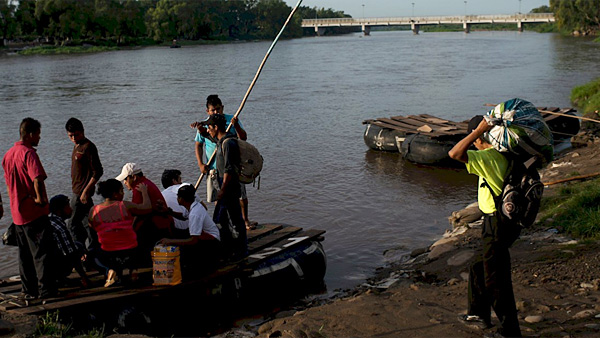
The Suchuiate River crossing between Mexico and Guatemala. Those with visas cross the bridge, and those without visas – including people fleeing violence from Central America – have to take a makeshift raft. (Encarni Pindado/Amnesty International)
Ten years ago I arrived in Mexico for the first time. A heavy backpack strapped around my waist, I toddled over a large, concrete bridge that divides Mexico and Guatemala.
When I crossed the border, a man with his shirt unbuttoned down to his belly and sweat pouring down his chest took my passport, glanced at it for no more than two seconds, then stamped it with a smile and cheerily barked to me “welcome to Mexico.”
My entry into Mexico couldn’t have been easier, because I’m from Australia and don’t need a visa. But for hundreds of thousands of men, women, children and entire families fleeing violence and crossing Mexico’s southern border from some of the most dangerous corners of the world, it is a very different story.
Instead of a smile, they will face unfounded suspicion, fear, prejudice and even hate.
Knowing full well of the likelihood of being denied entrance and, instead, facing possible deportation to the war-like horrors and violence in Honduras and El Salvador, many are effectively forced to enter clandestinely.
Ten years after I used this border crossing for the first time, I came back as part of an international observation mission and have spoken to dozens of people whose lives have been turned upside down. We spoke to a man in a wheelchair who had lost both of his legs when he fell off the freight train dubbed “The Beast” that migrants and asylum-seekers travel on top of to get through Mexico. He was taken to a hospital in Mexico, who then referred him to Mexican migration authorities. He told us that migration authorities ignored his request to lodge an asylum claim and deported him back to Honduras straight away. He said he spent just four days there, fearing for his life, and then came back to Mexico immediately. He had still been unable to lodge an asylum claim given his fear of being detained.
Some 400,000 people are estimated to be crossing Mexico’s southern border every year. Many of these are in need of international protection, and the United Nations High Commissioner for Refugees has called on governments in the region to recognise the humanitarian crisis affecting the Central American countries of El Salvador, Honduras and Guatemala.
Amnesty’s own research has shown how the generalised violence in El Salvador and Honduras makes them some of the deadliest places on the planet. A few days ago, I spoke to a young fisherman from El Salvador who had fled his country with more than 30 members of his family because the extortions and war taxes that criminal gangs imposed on them at home, and impose on entire industries in El Salvador in order to let them operate, made living there impossible. Saying no to gangs (“maras”) often means a death sentence.
Mexico has a history of receiving people fleeing violence and showing solidarity and hospitality to those in need of protection.
Read the rest at Amnesty International
Madeleine Penman is Mexico Researcher at Amnesty International
We invite you to add your charity or supporting organizations' news stories and coming events to PVAngels so we can share them with the world. Do it now!
Celebrate a Healthy Lifestyle
 From activities like hiking, swimming, bike riding and yoga, to restaurants offering healthy menus, Vallarta-Nayarit is the ideal place to continue - or start - your healthy lifestyle routine.
 Banderas Bay offers 34 miles of incomparable coastline in the states of Jalisco and Nayarit, and home to Puerto Vallarta and Riviera Nayarit's many great destinations.