
| Human Rights at a Crossroads in Mexico 24 Months After Ayotzinapa Janice Gallagher, Paula Martinez Gutierrez and Camila Ruiz Segovia - NACLA | |
| go to original September 27, 2016 |
 |
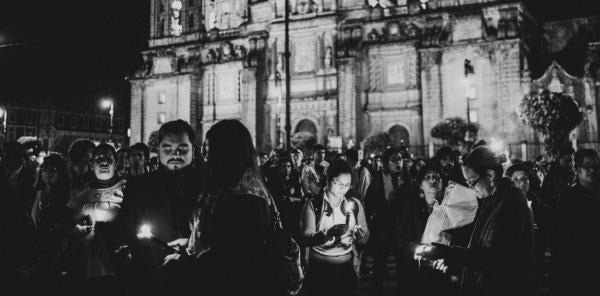
A protest in Mexico City's Zócalo shortly after the disappearance of the 43 students two years ago. (Ayotzinapatimeline.org)
Yesterday marked two years since the disappearance of 43 college students at the hands of Mexican police. After months of tireless efforts by civil society activists and the parents of the students themselves, 42 of 43 students still remain unaccounted for, one student is in a coma, and six other people are dead. The one student’s whose corpse was located shows signs of torture.
Listen: The search is still on in Mexico for answers in a human rights case that's divided the nation for the past two years. (PRI's The World)
As of yet, no federal police or military who are implicated in the disappearances have been criminally charged, and Mexican President Enrique Peña Nieto’s administration continues to stall investigation into their possible involvement. While the recent resignation of lead investigator Tomás Zerón was seen as a positive step, it’s not clear if this signals any real change in the investigation itself.
Meanwhile, the International Group of Experts, (GIEI, for its Spanish initials), appointed by the Inter-American Commission on Human Rights (IACHR) after widespread denunciations of the quality of the Mexican Attorney General’s investigation into the case, issued a critical final report in April. Their investigatory work has been championed by the parents of the missing students. However, the Mexican government chose not to renew their mandate, but agreed instead to a watered-down mecanismo de seguimiento (follow-up mechanism) to provide occasional international oversight into the investigation.
Today, U.S.-Mexico relations are dominated by reactions to Trump’s xenophobia, and Peña Nieto’s politically disastrous meeting with him. Substantive discussions of the human costs of the militarized border, drug war, and human rights in both countries today are scant.
Given these realities, it is tempting to write off the case as emblematic of a series of failures - of justice, of Mexico’s democracy, of the international human rights community. But the disappearance of the Ayotzinapa students and the subsequent investigations and struggles for justice still holds lessons about the nature and status of human rights, and the power of social movements compared to the power of states. The case also speaks to the wide gap between Mexico’s history of supporting pro-human rights agreements and agendas, versus the ways these laws actually function in practice.
Since September 26, 2014, we - a group of researchers working on social movements in Mexico - have put together a timeline, now available on nacla.org, in English and Spanish, highlighting key events of the Ayotzinapa disappearances and its aftermath, including local, state and international state and non-state reactions, key protests, and advances in the investigation. The contents of the timeline are a living, visual memory constituting an important piece of the puzzle in the struggle for human rights and dignity in Mexico today.
The timeline visually traces actions and reactions, from state responses to protests, the establishment of the International Group of Experts (GIEI), and state efforts to discredit them. The timeline covers the ways in which Mexican citizens have kept vigil for these students on the streets and within domestic non-governmental organizations. In addition, we systematically analyzed 334 different utterances made by those closest to the case. We also pored over judicial data and reporting to try to understand how the calls for justice translated - or didn’t - into actual changes.
Read the rest at NACLA
This article is the second part in a NACLA series reflecting on the Ayotzinapa case and commemorating the 43 disappeared students after two years. Read part one here. Be sure to check out the Ayotzinapa timeline in its new home at NACLA here.
Related: Mexico-Ayotzinapa Two years Later: 43 Still Disappeared, 180 Arrested ... No Convictions (Mexico Voices)
Related: Mexico's President Promises to Clarify Disappearance of 43 Students (Xinhua)
Related: Mexico-Ayotzinapa: Two Years of Continuing Damage (Mexico Voices)
Related: Will Canada Speak Up for the Disappeared in Mexico? (iPolitics)
We invite you to add your charity or supporting organizations' news stories and coming events to PVAngels so we can share them with the world. Do it now!
Celebrate a Healthy Lifestyle
 From activities like hiking, swimming, bike riding and yoga, to restaurants offering healthy menus, Vallarta-Nayarit is the ideal place to continue - or start - your healthy lifestyle routine.
 Banderas Bay offers 34 miles of incomparable coastline in the states of Jalisco and Nayarit, and home to Puerto Vallarta and Riviera Nayarit's many great destinations.