
| How the Mexican Government Saves Its Citizens from Executions in the U.S. Maurice Chammah - The Atlantic | |
| go to original September 22, 2016 |
 |
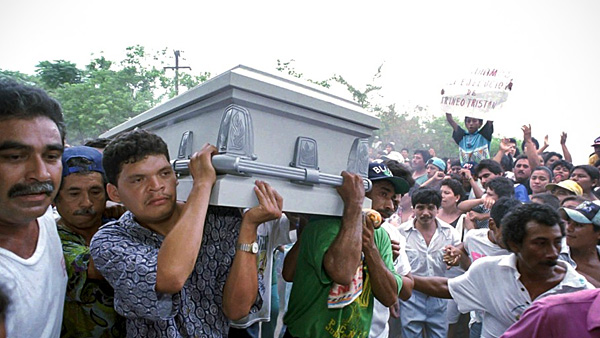
In Congregacion Anahuac, thousands follow the coffin of Irineo Tristan Montoya, who was executed in Huntsville prison, Texas. (Jose Luis Magana/AP)
When the body of 25-year old Lesley Hope Plott was found lying in a ditch in Russellville, Alabama, in February of 2013, police had little trouble zeroing in on a suspect: hours earlier, a nearby church’s security camera had recorded her being beaten and stabbed by her estranged husband, Angel Campos Nava.
Born in Mexico, Nava, 36, had come to the United States years earlier. He had already been convicted of assaulting Plott on two earlier occasions. A murder conviction could result in the death penalty. It was up to Rebecca Thomason, Nava’s lawyer, to convince the Franklin County district attorney to instead seek a life sentence, or, failing that, to convince a jury to spare his life. It didn’t help that Nava was undocumented, and they were in Alabama, a state with some of the harshest anti-immigration laws in the country.
Then, Thomason received a call offering her something few lawyers in death penalty cases get: money, training, and advice, courtesy of the Mexican government. Nava’s case had caught the attention of the Mexican Capital Legal Assistance Program, created by Mexican officials in 2000 to save the country’s citizens from execution in the United States.
One of the program’s chief purposes is to help defense attorneys construct a biography of the accused - to humanize them. Poverty, family dysfunction, and developmental disability are frequent themes in their clients’ lives. When presented as part of a defense, such themes can encourage mercy among jurors and dissuade them from handing down a death sentence.
To that end, the program arranges for lawyers to go to Mexico to track down school and hospital records and stories about their clients’ lives, either paying for their travel costs or advising them on how to request money from local courts. Under the program, Mexico pays American lawyers up to $220 an hour to track potential death penalty cases around the country - watching court decisions and news stories from the moment of arrest, all the way through the last minute scramble before an execution - and advise court-appointed lawyers like Thomason.
Since 2008, the program has provided these attorneys with an average annual budget of around $4 million to track as many as 135 cases at a time, according to the program’s filings with the Department of Justice. That comes out to roughly $29,000 per case, per year. By contrast, the Equal Justice Initiative, which represents numerous inmates on Alabama’s death row, has reported that many of them were sentenced to death after their attorneys’ fees were capped at $1,000 for out-of-court trial preparation.
More resources and training translates into more compelling stories, as defenders plead for mercy for their clients. Monica Foster, a lawyer in Indianapolis who worked with the program for several years, explained that she would connect defense attorneys with officials in Mexico, who would help them travel to their clients’ hometowns, many of which were often inaccessible by paved roads. “We’d help them understand... how you take that story and meld it into a complete package of ‘How did this person end up in [the United States] and why should a jury feel compelled to extend mercy to them?’”
Read the rest at The Atlantic
Related: Map: Which Countries Use the Death Penalty? (The Atlantic)
We invite you to add your charity or supporting organizations' news stories and coming events to PVAngels so we can share them with the world. Do it now!
Celebrate a Healthy Lifestyle
 From activities like hiking, swimming, bike riding and yoga, to restaurants offering healthy menus, Vallarta-Nayarit is the ideal place to continue - or start - your healthy lifestyle routine.
 Banderas Bay offers 34 miles of incomparable coastline in the states of Jalisco and Nayarit, and home to Puerto Vallarta and Riviera Nayarit's many great destinations.