
| After a Decade, Latin America's Rising Pink Tide Crashes on the Rocks Ryan McMaken - Mises Institute | |
| go to original September 15, 2016 |
 |
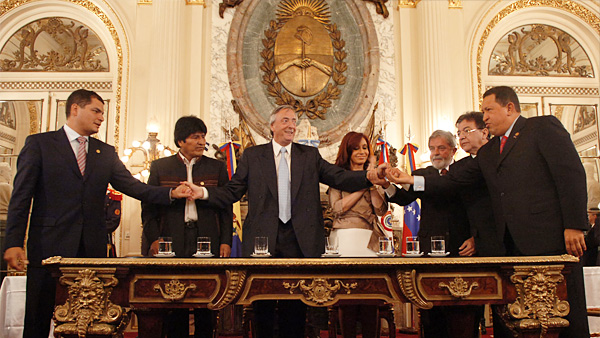
Rafael Correa, Evo Morales, Néstor Kirchner, Cristina Fernández, Luiz Inácio Lula da Silva, Nicanor Duarte, and Hugo Chávez at the signing of the founding charter of the Bank of the South (Wikipedia)
Ten years ago, South America was witnessing the rise of what came to be known as the "pink tide." Characterized by an allegedly kinder and softer version of socialism than the "red" communism of Castro's Cuba, the pink tide had begun with the election of Hugo Chavez in Venezuela in 1998, followed by the election of Lula da Silva in Brazil in 2002, and followed by the rise of the Kirchners in Argentina in 2003. The tide continued to roll in with the election of Evo Morales in Bolivia in 2006, and Rafael Correa's election in Ecuador in 2007.
As these new leftist candidates gained traction, their success was said to herald a new era of leftist politics in South America that would bring to an end the "neoliberal" consensus and impose a new, more humane economics on Latin American society.
Eighteen years after Hugo Chavez's inauguration, things haven't gone quite as planned.
The economy of Venezuela is in seemingly terminal decline with riots, shortages, and enforced slave labor imposed in an attempt to force more production out of the population. Meanwhile, the economies of Brazil and Argentina — while not comparable to Venezuela — are among the worst in Latin America, with Brazil heading for its its worst depression since 1901.
As economies worsened, corruption and authoritarian tactics worsened as well. Venezuelans have gotten the worst of it with citizens groaning under the weight of a police state that shuts down small business and persecutes even the smallest entrepreneurs for alleged economic "crimes" such as being a "class traitor." In her final years, Kristina Kirchner became increasingly autocratic and paranoid, going so far as to prosecute and impose fines on economists who made economic forecasts the Argentinian state found to be be unflattering. Meanwhile in Brazil, corruption reached new heights as President Rousseff — the pink-tide successor to da Silva — attempted to save the economy and her political career by showering her political allies with "stimulus" cash.
Much of the most serious damage has been limited to Venezuela, Brazil, and Argentina, however, as it seems the pink tide was never quite as deep or strong as many suspected it to be.
Read the rest at Mises Institute
We invite you to add your charity or supporting organizations' news stories and coming events to PVAngels so we can share them with the world. Do it now!
Celebrate a Healthy Lifestyle
 From activities like hiking, swimming, bike riding and yoga, to restaurants offering healthy menus, Vallarta-Nayarit is the ideal place to continue - or start - your healthy lifestyle routine.
 Banderas Bay offers 34 miles of incomparable coastline in the states of Jalisco and Nayarit, and home to Puerto Vallarta and Riviera Nayarit's many great destinations.