
| Sanam Malik: The Harrowing Lives and Traumas of Central American Refugees Sanam Malik - Center for American Progress | |
| go to original September 14, 2016 |
 |
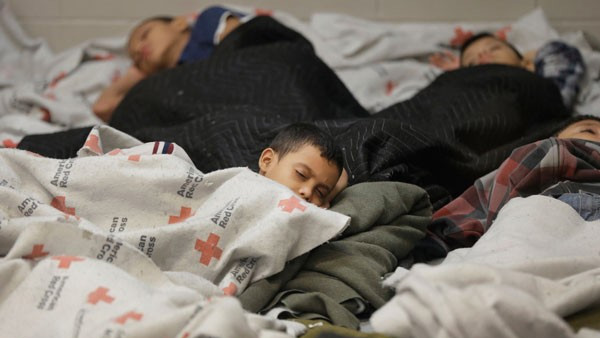
Children sleep in a holding cell at a U.S. Customs and Border Protection processing facility in Brownsville, Texas, in June 2014. (AP/Eric Gay)
Since 2014, tens of thousands of children and families from El Salvador, Honduras, and Guatemala, also known as the Northern Triangle region of Central America, have fled to the United States and neighboring countries to escape extreme violence and poverty. El Salvador, Honduras, and Guatemala are among the most violent countries in the world and the poorest in the Americas. El Salvador in particular has recently become the homicide capital of the world—a distinction previously held by Honduras—and its capital, San Salvador, averaged one murder every hour in 2015. In 2015, more than 1,000 children were violently killed in Honduras, and 153 children were killed just in the first five months of 2016.
Women and girls have reported being raped, assaulted, and threatened by gang members, in addition to facing domestic violence at home. In fact, from 2000 to 2012, the three Northern Triangle countries ranked globally in the top four for femicide, the killing of women and girls. Gangs and drug cartels are a rampant problem in these countries. Children are forced to make an impossible choice between either joining these gangs or being murdered, or having a family member murdered. Families are forced to pay extortion money and, if unable to do so, risk losing everything, including their lives. Citizens of these three countries pay an estimated $661 million in extortion money annually.
This violence is further exacerbated by extreme poverty, lack of opportunity, and often-dysfunctional justice systems. In addition to being among the most violent countries in the world, these countries are ranked among the very poorest in Latin America and the Caribbean, alongside Haiti. Furthermore, countries in the Northern Triangle deny justice and due process for many victims of crime due to a judicial system and magistrates that are influenced by gangs, cartels, bribery, and/or threats, which increases people’s sense of insecurity and further pushes them to seek security elsewhere.
Since the beginning of fiscal year 2014, more than 150,000 children and 160,000 parents with children have come to the United States seeking refuge. In the midst of this growing refugee crisis, the White House announced in July that the United States will work with the United Nations, as well as Mexico and countries in Central America, to expand refugee identification and processing in the region while increasing protection and resettlement efforts. Although this initiative is a step in the right direction, more action will be needed in the years ahead to protect children and families from unspeakable violence and death in their home countries.
This month, leaders from around the world will attend the U.N. General Assembly Summit on Large Movements of Migrants and Refugees, followed by President Barack Obama’s Leaders’ Summit on the Global Refugee Crisis in New York. As representatives from around the world prepare to discuss how to meet the needs of the global refugee situation, it is critical that the stories of extreme violence and danger faced by Central American refugees be part of the narrative.
The following is a collection of stories reported in the press and by nongovernmental organizations from 2014 to 2016 describing violence faced by children, women, and men in the Northern Triangle.
Read the rest at Center for American Progress
Related: Is Trump an Aberration? The Dark History of the "Nation of Immigrants" (TomDispatch)
Related: Pressure Builds for Measures to Stem Flow of Refugees from the South Heading for US (FT.com)
Related: No More Immigration Scams! LA County Cracking Down (MyNewsLA)
We invite you to add your charity or supporting organizations' news stories and coming events to PVAngels so we can share them with the world. Do it now!
Celebrate a Healthy Lifestyle
 From activities like hiking, swimming, bike riding and yoga, to restaurants offering healthy menus, Vallarta-Nayarit is the ideal place to continue - or start - your healthy lifestyle routine.
 Banderas Bay offers 34 miles of incomparable coastline in the states of Jalisco and Nayarit, and home to Puerto Vallarta and Riviera Nayarit's many great destinations.