
| KBI Findings on Dangerous Deportations Confirmed in USCIRF Report Ignatian Solidarity Network | |
| go to original August 4, 2016 |
 |
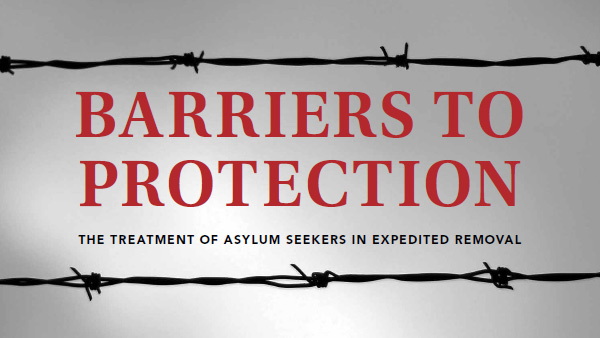
A report released earlier this week from the United States Commission on International Religious Freedom (USCIRF), Barriers to Protection: The Treatment of Asylum Seekers in Expedited Removal, confirms the first-hand testimony that the Kino Border Initiative (KBI), has gathered about individuals who are wrongly deported to danger. KBI, a work of the U.S. and Mexican Jesuits and other Catholic partners, is a binational organization that works in the area of migration and is located in Nogales, Arizona and Nogales, Sonora, Mexico.
The report shows that Customs and Border Protection (CBP) ignores migrants when they express fear and that they issue expedited removals to many individuals who should be afforded the opportunity to seek asylum. They deport these individuals back to the dangerous, life-threatening situations they fled without ever having a credible fear interview.
The USCIRF found through interviews and observations that CBP officers and agents often fail to ask individuals whether they are afraid of returning to their country, ignore migrants’ responses when they express fear, and are highly skeptical of migrants’ stories of the violence they flee. The report also found that Border Patrol’s internal guidance on their role inaccurately says that agents are responsible for determining whether and individual has credible fear, when that is in fact the role of an asylum officer. Many of the recommendations that USCIRF made in their last report in 2005 have not been followed, which is why these troubling trends continue and KBI constantly receives first hand testimony of individuals who have had their rights ignored.
HISTORY OF REMOVALS: The use of expedited and summary removals has been expanded several times between 1996 and 2004, allowing immigration agents to issue removal orders without an individual seeing an immigration judge. At the time of this expansion, both advocates and congressional representatives were concerned that the use of these orders would unjustly impact individuals migrating for fear of persecution.
KBI FINDINGS: According to KBI’s intake surveys, from January to June 2016, 5% of deported Mexican men and 7% of deported Mexican women in KBI’s aid center in Nogales, Sonora reported the violence they face in Mexico as their primary reason for migration. That means that every month this year, around forty Mexican individuals who were deported to Nogales, Sonora were entitled to have their cases considered by an asylum officer and an immigration judge but were not afforded that opportunity.
COMPLAINTS FILED BY THE KBI: Since November of 2015, the KBI has filed ten complaints on behalf of individuals who expressed fear of returning to Mexico, but instead of being given the opportunity to speak with an asylum officer, they were deported by Border Patrol agents, Customs and Border Protection officers, or Immigration and Customs Enforcement agents. These complaints include the following cases:
- A Mexican woman who fled her native country when she was threatened by the same group that kidnapped, tortured, and killed her brother. She crossed the border five times and every time expressed her fear to Border Patrol agents. Her concerns were consistently dismissed. One agent responded by saying that in the US there are school shootings, so there is no reason to think she would be safer here. On another occasion, an agent said that the kind of violence she described does not occur in Mexico City. Five times over the course of several months, she was removed to Mexico with no opportunity to seek asylum.
- A Mexican man who fled due to persecution and harassment he had suffered on the basis of his sexual orientation. He said that when he was detained while crossing the border, he insisted for several minutes that he was fleeing persecution and would like to seek asylum. Instead, he was given an expedited removal order.
- A Mexican woman who fled because criminal gangs had infiltrated her town and were targeting and raping women. She reported that when she expressed fear of returning to Mexico, the Border Patrol agent responded that there are also gangs in the United States, so she has no reason to believe she would be safer here.
Under US law and international law, each of these individuals deserved to have their claims of fear evaluated by a qualified asylum officer in a credible fear interview. But that right was denied.
Read the rest at Ignatian Solidarity Network
Related: Serious Flaws in U.S. Treatment of Asylum Seekers in Expedited Removal: Children Especially (United States Commission on International Religious Freedom)
Related: Asylum Seekers Face Barriers to Stay in the U.S. as Immigration Agents Fail to Follow the Law (ThinkProgress)
We invite you to add your charity or supporting organizations' news stories and coming events to PVAngels so we can share them with the world. Do it now!
Celebrate a Healthy Lifestyle
 From activities like hiking, swimming, bike riding and yoga, to restaurants offering healthy menus, Vallarta-Nayarit is the ideal place to continue - or start - your healthy lifestyle routine.
 Banderas Bay offers 34 miles of incomparable coastline in the states of Jalisco and Nayarit, and home to Puerto Vallarta and Riviera Nayarit's many great destinations.