
| Mexico Needs to Improve Control of Toxic Chemicals Emilio Godoy - Inter Press Service | |
| go to original May 7, 2016 |
 |
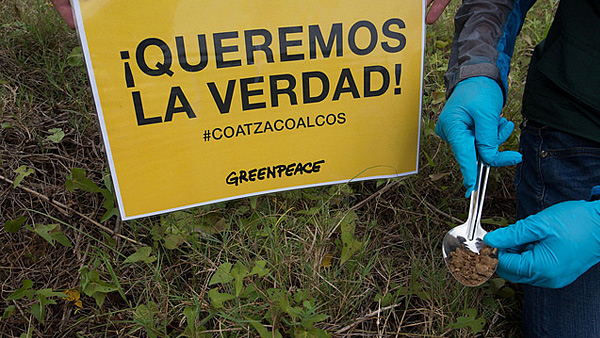
“We want the truth!” about what happened in an explosion of a polyvinyl chloride (PVC) plant in a petrochemical complex in the city of Coatzacoalcos in southeast Mexico, reads a Greenpeace sign, while a technician takes a soil sample after the disaster. (Greenpeace Mexico)
A recent explosion at a petrochemical plant in southeast Mexico highlighted the need to strengthen monitoring of hazardous substances, step up inspections of factories and update regulations in this country.
The Apr. 20 blast at the Clorados III plant in the Pajaritos Petrochemical Complex in the port city of Coatzacoalcos, Veracruz state, left 32 dead and 136 injured.
“One basic problem is the handling of toxic chemicals,” Robin Perkins, the Detox Programme leader at Greenpeace Mexico, told IPS. “This is a country with few regulations and the list of regulated and controlled substances is short. There is a lack of regulations, inspections and reviews.”
The plant, which belongs to Petroquímica Mexicana de Vinilo (PMC), a public-private petrochemical company, produces 170,000 tons a year of polyvinyl chloride (PVC), which generates dioxins and furans, and has two incinerators.
Dioxins and furans are environmental pollutants that belong to the so-called “dirty dozen” – a group of dangerous chemicals known as persistent organic pollutants (POPs). According to the World Health Organisation (WHO), POPs are present throughout the food chain and bio-accumulate in organisms.
Vinyl chloride, a known carcinogen, is found in gas and liquid form, and through inhalation or contact with skin it can cause dizziness, drowsiness, and headaches, while long-time exposure can lead to severe skin problems or liver damage.
Dioxin exposure has been linked to birth defects, miscarriage, learning disabilities, immune system suppression, lung problems, skin disorders and other health problems.
“It is important to monitor these kinds of chemicals, not only through environmental samples but also in the biota, and in exposed human populations, such as workers or local residents,” said Fernando Díaz-Barriga, a researcher at the Coordination for the Innovation and Application of Science and Technology at the public Autonomous University of San Luis Potosí.
To do that, he told IPS, “they must be detected in sediments and soils.”
Read the rest at Inter Press Service
IPS is an international communication institution with a global news agency at its core, raising the voices of the South and civil society on issues of development, globalisation, human rights and the environment. Check out the website at IPSNews.net
We invite you to add your charity or supporting organizations' news stories and coming events to PVAngels so we can share them with the world. Do it now!
Celebrate a Healthy Lifestyle
 From activities like hiking, swimming, bike riding and yoga, to restaurants offering healthy menus, Vallarta-Nayarit is the ideal place to continue - or start - your healthy lifestyle routine.
 Banderas Bay offers 34 miles of incomparable coastline in the states of Jalisco and Nayarit, and home to Puerto Vallarta and Riviera Nayarit's many great destinations.