
| Employees in Mexico Work Long Hours, Lack Educational Background, OECD Finds Emily Pickrell - Bureau of National Affairs | |
| go to original April 13, 2016 |
 |
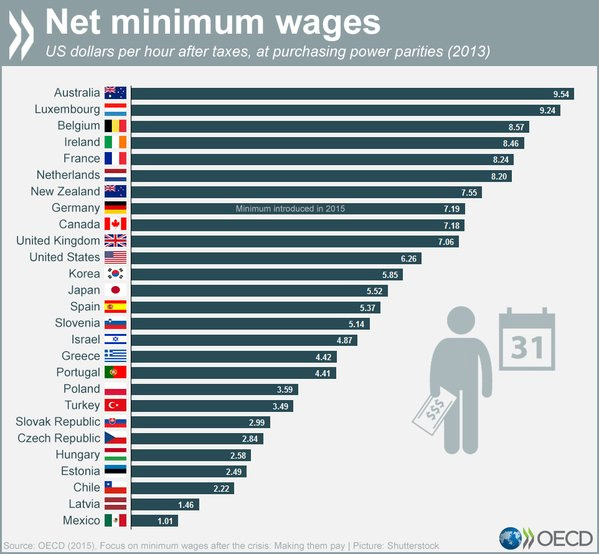
Mexicans worked longer hours in 2015 than employees in nearly all other industrialized countries but are still hampered in productivity and earning power by relatively low levels of education, according to a recent study issued by the Organization for Economic Cooperation and Development.
Nearly 30 percent of Mexican employees work more than 50 hours a week on average, according to the OECD’s Better Life Index, a study on quality of life issues in OECD countries.
The long hours, more than twice the OECD average, result from a corporate culture that emphasizes attendance over productivity, according to Duncan Wood, director of the Woodrow Wilson Center’s Mexico Institute.
“There is a very hierarchical labor relationship in Mexico,” Wood said in an interview with Bloomberg BNA. “You are there at the beck and call of the boss. In the Mexican corporate culture, it is not how much you produce but how long you spend at the workplace, and you don’t go home before your boss does.”
All this work has not helped raise the productivity of Mexico's workforce, however, owing in good part to the country's low levels of worker education. Only 37 percent of adults aged 25-64 in Mexico have completed upper secondary education, according to the OECD study, while more than 75 percent of all OECD workers have, making the Mexican workforce one of the least educated among member countries.
Read the rest at Bureau of National Affairs
Related: World’s Highest Minimum Wages – Australia Tops List, Mexico at the Bottom (Economic Collapse News)
We invite you to add your charity or supporting organizations' news stories and coming events to PVAngels so we can share them with the world. Do it now!
Celebrate a Healthy Lifestyle
 From activities like hiking, swimming, bike riding and yoga, to restaurants offering healthy menus, Vallarta-Nayarit is the ideal place to continue - or start - your healthy lifestyle routine.
 Banderas Bay offers 34 miles of incomparable coastline in the states of Jalisco and Nayarit, and home to Puerto Vallarta and Riviera Nayarit's many great destinations.