
| Investor Insight: How Strong Is Mexico's Economy? Nathaniel Parish Flannery - Forbes | |
| go to original September 8, 2015 |
 |
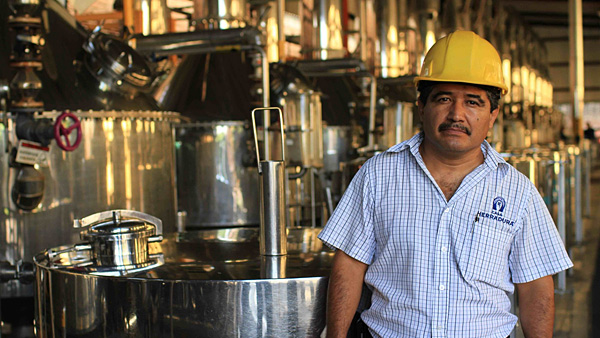
A production manager stands in front of the industrial distillation equipment in Herradura’s factory in Jalisco, Mexico. (N. Parish Flannery/Instagram)
On September 2, Mexico’s President Enrique Peña Nieto gave his annual state of the union address at the regal Palacio Nacional in Mexico City’s historic center. The speech tacitly acknowledged Mexico’s government’s struggles to improve public security and kick-start meaningful economic growth. Peña Nieto, after all, had seen his approval rating plummet to 35% this past year as scandal after scandal, including the abduction of 43 student teachers, the cancelation of a major public works contract, and the escape of cartel boss Joaquin “El Chapo” Guzman tarnished the country’s image. “Our country was deeply hurt by a series of cases and terrible events…[that] have damaged the mood of Mexicans as well as their confidence in government institutions,” Peña Nieto explained in his speech.
Peña Nieto also warned about the dangers of turning towards populism and demagoguery during the crisis. After all, although many Mexicans adore folksy heroes such as Pancho Villa and Emiliano Zapata, and revere Lazaro Cardenas, the populist president who served in office from 1934 to 1940, and nationalized Mexico’s oil sector and invested heavily in rural education, it is Cardenas’ successor, Miguel Aleman, who is credited with helping to forge the country’s modern growth trajectory by investing heavily in infrastructure and industry. In his book Distant Neighbors, Alan Riding argues that Aleman “firmly believed that wealth must be formed before it can be distributed…growth first and justice later.”
Mexico’s economy surged at an average pace of 5.5% between 1940 and 1980 but was ultimately brought down by irresponsible fiscal policy and the inefficiencies of corrupt and heavily protected state-owned enterprises. During the administrations of presidents Miguel de la Madrid and Carlos Salinas during the 1980s, a new generation of Mexican technocrats radically transformed the economy and built up a more solid foundation. With the signing of NAFTA, Mexico cemented its new strategy in place, opening to global commerce, and catalyzing a promising a new era of (potential) prosperity.
Read the rest at Forbes
We invite you to add your charity or supporting organizations' news stories and coming events to PVAngels so we can share them with the world. Do it now!
Celebrate a Healthy Lifestyle
 From activities like hiking, swimming, bike riding and yoga, to restaurants offering healthy menus, Vallarta-Nayarit is the ideal place to continue - or start - your healthy lifestyle routine.
 Banderas Bay offers 34 miles of incomparable coastline in the states of Jalisco and Nayarit, and home to Puerto Vallarta and Riviera Nayarit's many great destinations.