
| A Guide to the Coming Weirdness of El Nino Ali Swenson and John Walsh - TakePart | |
| go to original August 10, 2015 |
 |

Wildfires torched 2 million acres in Australia. A blistering heat wave killed 2,800 in Indonesia. Thailand’s rice crop failed, causing prices to spike 80 percent. An “atmospheric river” flowed over Northern California, making it rain in San Francisco on 27 days in a single month.
These are just a few of the dramatic effects of the El Niño years of 1982–83 and 1997–98, two of the strongest on record, in the Pacific Rim. This year's El Niño, according to the National Oceanic and Atmospheric Administration, could be even stronger, and researchers are finding strong evidence that global climate change could be a cause.
El Niño is a phenomenon that occurs irregularly in the tropical Pacific Ocean, usually at intervals of between two and seven years. (The name means "the boy" or "the little boy" in Spanish; South American fishers who originally recognized the phenomenon named it in reference to Jesus because they noticed temperatures were much warmer around Christmas.)
In a normal year, trade winds blow across the tropical Pacific Ocean from the east - Peru to Indonesia. During an El Niño, those winds weaken, reducing the upwelling of cold water off South America, so the surface water stays warm. Storms typically occurring when oceans are warm - hurricanes happen in summer and early fall, remember - then become more prevalent off the coasts of the Americas. Because the winds aren’t carrying the warm waters to the west, bringing storms with them, Indonesia and Australia suffer droughts. With all the energy the abnormally warm water releases into the atmosphere, El Niño can affect weather virtually anywhere on Earth.
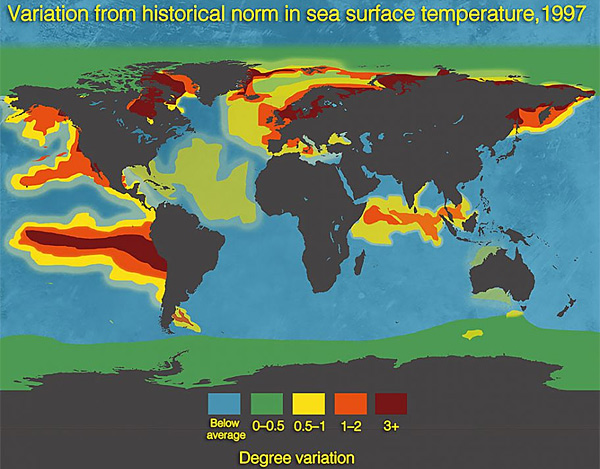
Here’s how El Niño looked in the summer of 1997:
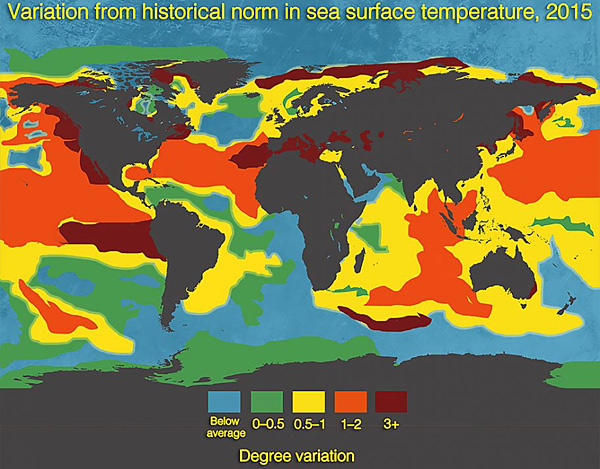
Here’s what global sea surface temperature anomalies look like this summer:
Read the rest at TakePart
Illustrations by Lauren Wade; Data from U.S. Navy
We invite you to add your charity or supporting organizations' news stories and coming events to PVAngels so we can share them with the world. Do it now!
Celebrate a Healthy Lifestyle
 From activities like hiking, swimming, bike riding and yoga, to restaurants offering healthy menus, Vallarta-Nayarit is the ideal place to continue - or start - your healthy lifestyle routine.
 Banderas Bay offers 34 miles of incomparable coastline in the states of Jalisco and Nayarit, and home to Puerto Vallarta and Riviera Nayarit's many great destinations.