
| In the Apparel Industry, Abusive and Deadly Working Conditions Are Still the Norm Erik Loomis - Working In These Times | |
| go to original July 10, 2015 |
 |
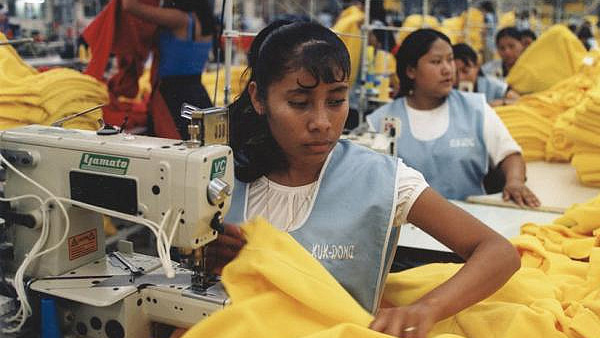
While Americans only pay attention when extreme tragedies strike, incredible levels of abuse are the norm in the factories around the world that produce the goods we consume every day. (marissaorton/Flickr)
Today, American citizens simply cannot know the working conditions of the factories that make the products they buy. We cannot know how the chemicals, tools, and technologies in these workplaces affect workers. Some brave workers publicize their conditions, and investigative institutions such as Human Rights Watch expose some of the worst violations, but there is an enormous knowledge gap.
This is hugely beneficial for corporations who want to keep us ignorant of their activities. We know about extreme incidents such as the Rana Plaza collapse that capture the world’s attention, however briefly, or when workers get so fed up with the conditions that they strike long enough and loud enough to get the Western world’s attention. But the day-to-day disasters that maim or kill a single worker or the accumulation of lead in workers’ bodies - those go almost completely unreported.
Much of that has taken place in the apparel industry, which has replicated Triangle-era conditions in sweatshops around the world. That it continues targeting women for this exploitative work is hardly surprising, as garment manufacturers did this in New England and the South in the twentieth century. Women need and want to work. For women in the developing world, work can be empowering, providing extra income, independence, or a way to escape an abusive relationship. Theoretically, American companies could provide this empowerment if they paid women a decent wage and employed them in clean factories that did not collapse or catch fire. But as geographer Melissa Wright has noted, employers see these women as “disposable,” workers to wring every ounce of profit from and then throw their “worthless” bodies out like garbage.
This attitude pervades the entire garment industry. It is hardly surprising then that many women choose the sex trade over the garment industry in nations like Cambodia. The pay is much better.
Some of the first industries to migrate to Mexico en masse after the Border Industrialization Program started were electronics and textiles - relatively low-skill and low-overhead industries find moving to flee regulations highly profitable. By 1994, 2,065 Mexican factories specifically opened using maquiladora legislation employed 579,519 people, nearly all in jobs migrated from the United States. Mexico was only the tip of the iceberg, and by the 1990s the geography of production extended into Central America and through Southeast Asia. This made American companies tremendous amounts of money. In 1993, the cost of labor in Malaysia was 10 percent of that in the United States, and in China it was only 3 percent.
Read the rest at Working In These Times
"Working In These Times" is dedicated to providing independent and incisive coverage of the labor movement and the struggles of workers to obtain safe, healthy and just workplaces.
We invite you to add your charity or supporting organizations' news stories and coming events to PVAngels so we can share them with the world. Do it now!
Celebrate a Healthy Lifestyle
 From activities like hiking, swimming, bike riding and yoga, to restaurants offering healthy menus, Vallarta-Nayarit is the ideal place to continue - or start - your healthy lifestyle routine.
 Banderas Bay offers 34 miles of incomparable coastline in the states of Jalisco and Nayarit, and home to Puerto Vallarta and Riviera Nayarit's many great destinations.