
| Mexicali Tour, From Tummy Tuck to Root Canal Jennifer Medina - New York Times | |
| go to original June 28, 2012 |
 |
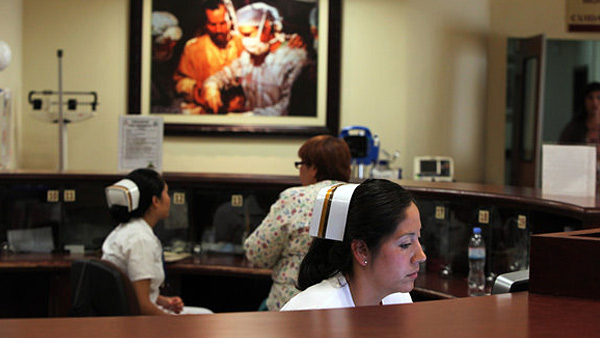
The nurses’ station at Hospital Almater in Mexicali, Mexico, where many patients come from outside Mexico. (Monica Almeida/New York Times)
MEXICALI, Mexico — Tourists often come to border towns looking for some kind of illicit adventure, trotting among the bars, strip joints and seedy motels that dot the streets. Here, though, the visitors are searching for something more basic: a root canal they can afford or surgery they have been putting off for months.
Mexicali has adopted medical care as its primary tourist lure, and it has been attracting a growing number of health care commuters from California and other nearby states. Hospitals offer operations for gastric bypass, liposuction and chronic back pain. Dentists promise that extractions, fillings and whitening can all be done for less money. And ophthalmologists advertise laser surgery and routine exams.
As the United States approaches the climax of a fierce national debate over the Obama administration’s health care law, which would significantly increase the number of people covered by medical insurance, thousands of people are crossing the border in search of care they either cannot afford or wish to get more cheaply. The influx has grown steadily over the last several years, attracting uninsured Mexicans who have made their lives in the United States and desperately need affordable care. But it increasingly includes a smaller but growing group of middle-class patients from all over the country looking for deals on elective surgeries that most medical insurance will not cover.
“At first, I was like, Mexicali, where is that?” said Stephanie Rusky, a 26-year-old social worker from Perkins, Okla., who paid roughly $8,000 for some liposuction, a breast lift and a tummy tuck (a combination known as a “mommy makeover”) that would have cost about twice that in the United States. “But I asked every question I could think of and eventually felt really comfortable with it.”
Such sentiments are sweet music to the ears of Omar Dipp, who oversees tourism for the city.
“There’s a huge market for this,” Mr. Dipp said. “We just have to package it the right way. Everyone benefits: the hotels, the restaurants, the local economy. We give them a reason to come, and they will be here.”
Last year, more than 150,000 patients came to Mexicali, pumping more than $8 million into the city’s economy, officials said. There are some dozen hospitals that regularly see Americans, and many have a special administrator to coordinate medical and travel plans. With nearly 100 medical offices in a six-block radius, the city hopes to create a special medical zone by improving streets and sidewalks and adding more services for tourists.
Just across the border in Southern California, the small city of Calexico has struggled for decades. The area has one of the highest unemployment rates in the country.
Many of the residents in the Imperial Valley there rely on seasonal agricultural work and have no insurance. For them, coming to Mexicali for care can seem obvious. A few insurance providers have even expanded some coverage into Mexico, encouraging their customers to seek the less expensive care. A 2010 study showed that roughly 85 percent of those who crossed the border for medical care were Spanish speakers, but Mr. Dipp said he expected more and more “blue-eyed Americans” in the coming years.
In strip malls and office buildings here, there are far more medical offices than anything else. Hotels offer special rates for patients, and the local tourism office has begun subsidizing van rides from Las Vegas to bring in those who would rather avoid the drive themselves. And this year, the government opened a special lane to allow medical tourists to bypass most of the wait on the Mexican side of the border, which can often take as long as three hours.
The doctors, with strong support from the local government, are hoping to attract more Americans for elective procedures or more basic care that they may not be able to afford at home. And many here believe that the market will only grow as health care costs continue to rise and more people, particularly low-wage workers along the border, are desperate to find affordable care.
Read more at The New York Times
We invite you to add your charity or supporting organizations' news stories and coming events to PVAngels so we can share them with the world. Do it now!
Celebrate a Healthy Lifestyle
 From activities like hiking, swimming, bike riding and yoga, to restaurants offering healthy menus, Vallarta-Nayarit is the ideal place to continue - or start - your healthy lifestyle routine.
 Banderas Bay offers 34 miles of incomparable coastline in the states of Jalisco and Nayarit, and home to Puerto Vallarta and Riviera Nayarit's many great destinations.