
| Domestics in Mexico Face Abuse, Discrimination and Scant Protection Emilio Godoy - Inter Press Service | |
| go to original June 17, 2015 |
 |
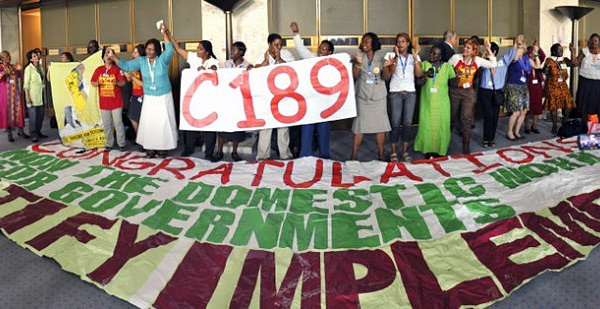
Domestics celebrating the approval of the convention concerning decent work for domestic workers (Convention No. 189) at International Labour Organisation headquarters in Geneva. (ILO)
Her last two jobs left a bitter taste in the mouth of Yoloxochitl Solís, a 48-year-old single mother from Mexico. She sums up the experience in two words: abuse and discrimination.
“My employer would throw the food and medicine back in my face,” Solís told IPS. “She started to be rude to me, because she didn’t like me to say hello to people who were visiting her, she wanted me to stay shut up in the kitchen – I couldn’t even go out to the bathroom.”
Solís, who raised her 24-year-old son on her own, and whose first name means “flower heart” in the Náhuatl indigenous tongue, worked from 2000 to 2005 in a home in Villa Olímpica, a middle-class neighborhood on the south side of Mexico City, where she cleaned, cooked and took care of a woman in her eighties.
“The hostile way she treated me was really strange, because there was no reason for them to discriminate against anyone,” she said, talking about the elderly woman and her son, who was in his sixties.
She earned roughly 20 dollars a day, two of which paid for her one-hour commute to and from work every day. Her workdays were long, from Monday through Saturday, and the only benefit she received was a small annual bonus. Tired of the mistreatment, she finally quit.
But her next job was even worse. She was recommended by a nephew, and began to look after a stroke victim who had two children, also in Villa Olímpica.
Theoretically her workday was from 8:30 to 15:00. “But I would leave as late as eight o’clock at night; there was always something to do, and even if I was ill, I couldn’t miss work.”
In March, Solís ended up sick in bed with a fever in her home in the poor neighbourhood of Magdalena Contreras, to the south of Mexico City. “They shouted at me, insulted me, wouldn’t listen,” she said. As a result, she quit the job she had since 2006.
Stories like hers are routine in Mexico, where domestic workers suffer discrimination, exploitative working conditions, sexual harassment and low wages, with little protection from the law.
Read the rest at Inter Press Service
IPS is an international communication institution with a global news agency at its core, raising the voices of the South and civil society on issues of development, globalisation, human rights and the environment. Check out the website at IPSNews.net
We invite you to add your charity or supporting organizations' news stories and coming events to PVAngels so we can share them with the world. Do it now!
Celebrate a Healthy Lifestyle
 From activities like hiking, swimming, bike riding and yoga, to restaurants offering healthy menus, Vallarta-Nayarit is the ideal place to continue - or start - your healthy lifestyle routine.
 Banderas Bay offers 34 miles of incomparable coastline in the states of Jalisco and Nayarit, and home to Puerto Vallarta and Riviera Nayarit's many great destinations.