
| What Global Polio Eradication Could Mean for Your Health Security CDC.gov | |
| go to original April 29, 2015 |
 |
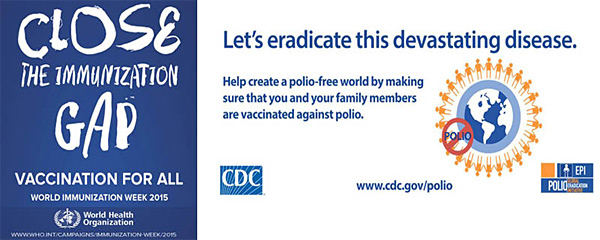
Globalization has brought global health right to our door-step. In a world where everything from global trade to international travel is on the rise, the infectious disease threats of one region of the world can easily become public health threats present in your own backyard.
While it is often the unfamiliar and rare diseases that are thrown into the public spotlight as global health security threats, infectious diseases of all types can be a danger to public health - even a virus that has not been present in the United States for over 30 years, like polio.
“Scenarios for polio being introduced into the United States are easy to imagine, and the disease could get a foothold if we don’t maintain high vaccination rates,” explains CDC’s Dr. Greg Wallace, Team Lead, Measles, Mumps, Rubella, and Polio, Epidemiology Branch, Division of Viral Diseases, National Center for Immunization and Respiratory Diseases. “For example, an unvaccinated U.S. resident could travel abroad and become infected before returning home. Or, a visitor to the United States could travel here while infected. The point is that one person infected with polio is all it takes to start the spread of polio to others if they are not protected by vaccination.”
Today, the average American’s experience with the polio virus does not expand far beyond the black-and-white images of iron-lungs and children in leg braces from our history text books, and the vaccinations received as a child.
The polio virus was the most feared disease of the 20th century, and ravished the United Stated during the late 1940s through early 1950s - crippling nearly 35,000 people in the U.S. each year. Today the U.S. has remained polio-free for over 30 years, thanks to effective vaccines and the high coverage of people who have been vaccinated. Still, the poliovirus is a contagious disease and the threat of polio anywhere means that polio poses a threat everywhere.
Global efforts to end polio worldwide began in 1988 with the launch of the Global Polio Eradication Initiative (GPEI), and have seen great success in the majority of the world. Today 80% of the world’s population lives in polio-free areas. Despite the tremendous successes, three countries still have not interrupted the transmission of wild poliovirus - Afghanistan, Nigeria, and Pakistan. As long as polio remains present in these countries, it presents a threat to children worldwide.
The goal of global polio eradication is to ensure that polio ceases to infect any persons worldwide. Global eradication will save billions of dollars and prevent the paralysis of nearly 200,000 children each year.
Read the rest at CDC.gov
We invite you to add your charity or supporting organizations' news stories and coming events to PVAngels so we can share them with the world. Do it now!
Celebrate a Healthy Lifestyle
 From activities like hiking, swimming, bike riding and yoga, to restaurants offering healthy menus, Vallarta-Nayarit is the ideal place to continue - or start - your healthy lifestyle routine.
 Banderas Bay offers 34 miles of incomparable coastline in the states of Jalisco and Nayarit, and home to Puerto Vallarta and Riviera Nayarit's many great destinations.