
| Mexico's Escalating Labor Strike in Baja California's San Quentin Region J. Tadeo - Global Voices | |
| go to original April 27, 2015 |
 |
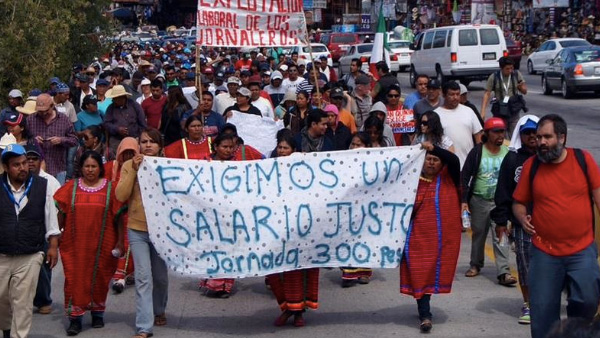
San Quintin's laborers protesting for labor improvement conditions. (Image shared on social networks)
The coastal region of San Quentin in Baja California has been in international headlines since mid-March, due to a labor dispute by agricultural workers.
The Russian news network RT reports that 50,000 laborers are protesting unfair working conditions, leading to some violence. According to the Canadian Centre for Research on Globalization, the strike has disrupted the harvesting, packing, and shipping of zucchini, tomatoes, berries, and other products to shops and restaurants in the United States. Workers demand salary increases and benefits required by law, including social security.
The conflict now seems to be spreading beyond a mere labor dispute, fast growing into a conflict over migratory and indigenous issues. Andrew Selee, the executive vice president of the Wilson Center in the United States, says the dispute has taken on new dimensions:
The vast majority of the workers are people from Mixtec indigenous origin from Oaxaca and Guerrero. This movement has taken on transnational dimensions with the strikers marching to the Mexico-US border in April 2015, where they met with other indigenous farm workers, who went to the border from the other side to support them. They met in a park near the beach to have a bilateral meeting with protesters from both sides of the border, divided by the fence that separates the two countries, but joined by their hopes for a better future.
The states of Oaxaca and Guerrero are located in the southern part of Mexico, which means there is some internal migration at work, if workers from these regions are amassing in Mexico's northern-most territory.
The website Animal Politico has gone even further, comparing the issue to slavery, citing the Global Slavery Index, an annual report published by the Walk Free Foundation. Animal Politico, however, reports that Mexico's ranking on this index is 18th, though it is in fact 111th. The report on Mexico is still alarming, regardless, as it estimates that 266,900 people in Mexico today live in “modern slavery.” The Walk Free Foundation says the most vulnerable groups are women, children, and indigenous people.
As alarming as the San Quentin protests have been, reactions online have also raised questions. Accordng tot he website Sopitas, Facebook users created a page that where people posted hate speech aimed at the workers on strike: “They're worse than cockroaches” says the [Facebook] page, called “Oaxacos Extermination in Baja California.”
“Oaxaco” is a pejorative word used by people in the north to refer to people from the country's south (not necessarily from Oaxaca) and the center. A large number of these people are ethnically close to the Native Americans, consisting of many differing tribes with a wide variety of dialects.
Mexican society faces serious problems of inequality and social classism, which are only exacerbated by low average salaries. The minimum wage, for instance, is just five dollars a day.
Translated by Liliane Tambasco
See the original at Global Voices
We invite you to add your charity or supporting organizations' news stories and coming events to PVAngels so we can share them with the world. Do it now!
Celebrate a Healthy Lifestyle
 From activities like hiking, swimming, bike riding and yoga, to restaurants offering healthy menus, Vallarta-Nayarit is the ideal place to continue - or start - your healthy lifestyle routine.
 Banderas Bay offers 34 miles of incomparable coastline in the states of Jalisco and Nayarit, and home to Puerto Vallarta and Riviera Nayarit's many great destinations.