
| Six Canoers on 5,200-Mile Trek to Arctic Ocean RediscoverNA.com | |
| go to original April 11, 2015 |
 |
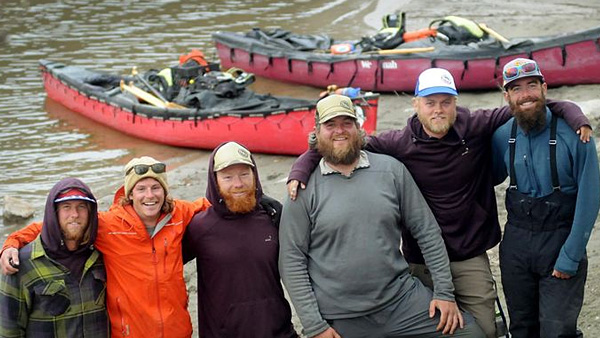
Four Minnesotans and a pair of Iowans made a brief stop in Mankato, Minnesota, before resuming their 5,200-mile canoe trip from the Gulf of Mexico to the Arctic Ocean. From left are Jarrad Moore, Luke Kimmes, Adam Trigg, John Keaveny, Dan Flynn and Winchell Delano. (John Cross/Mankato Free Press)
If they reach their destination, the trip will cover nine months, the length of two nations, 5,200 miles (mostly against the current) and millions of stokes of the canoe paddle.
The journey begins in the Mississippi Delta near Buras, Louisiana. From there, it is a long 2,000 miles upriver, traveling north through Memphis, Tennessee and Saint Louis, Missouri (among many other US cities) before they reach the Minnesota River, which lies just south of Minneapolis/Saint Paul. The Minnesota River flows southwest for 70 miles before altering its course back northwest. They will follow the Little Minnesota River, one of the Minnesota's tributaries, and head-up to Browns Valley, Minnesota. After a short portage, they'll arrive on Lake Traverse and follow the Bois des Sioux River to the Red River, which flows all the way to Lake Winnipeg across the border between the United States and Canada. By the time they're on the north end of Lake Winnipeg, they'll have already traveled over 3,000 miles.
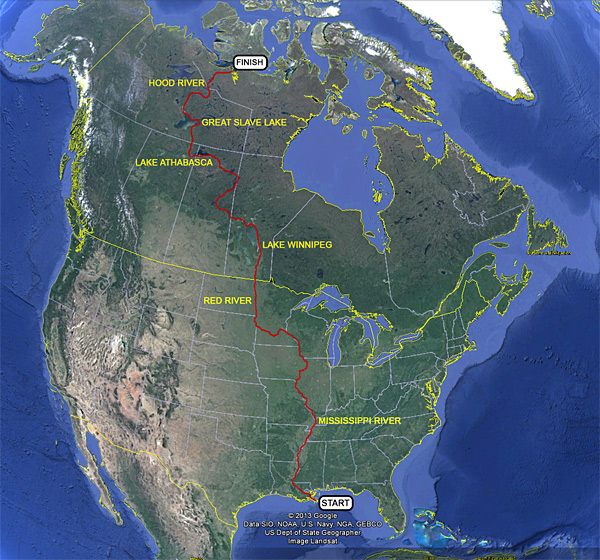
The Saskatchewan River flows into the northwest end of Lake Winnipeg. They'll travel upriver on the Saskatchewan and follow one of its tributaries, the Sturgeon-Weir River, until they reach Frog Portage. From there, they'll paddle the classic route on the Churchill River through Reindeer Lake, up the Cochrane River to Wollastan Lake, and then down the Fon du Lac River to Lake Athabaska. The Slave River flows out the west end of Lake Athabaska 200 miles before reaching Great Slave Lake. It's a lot of shoreline along the northeast arm of Great Slave Lake and back west through Yellowknife before they travel upstream on the Yellowknife River. They'll continue upstream on the Winter River, a tributary of the Yellowknife before heading downstream on the Parent River. The Parent River joins the Coppermine River, and from there it is about 100 miles before the Fairy Lake River, which will take us to Napaktulik Lake and their final height of land. On the other side, the Hood River is waiting, and flowing into Bathurst Inlet, their ending site.
Seasoned paddlers and weekend warriors alike will probably notice that this trip borrows from a number of well-traveled and beloved routes through the U.S. and Canada. Eric Sevareid's Canoeing with the Cree, the Borealis Expedition in 2008, and numerous myccr message boards (among many others) can claim some ownership, no doubt. Like the Trans-Territory Expedition in 2012, they're just a bunch of borrowers who like to connect the dots and see what kind of adventure they can come up with.
More details on the expedition, including photographs and an occasional journal, are available at RediscoverNA.com
We invite you to add your charity or supporting organizations' news stories and coming events to PVAngels so we can share them with the world. Do it now!
Celebrate a Healthy Lifestyle
 From activities like hiking, swimming, bike riding and yoga, to restaurants offering healthy menus, Vallarta-Nayarit is the ideal place to continue - or start - your healthy lifestyle routine.
 Banderas Bay offers 34 miles of incomparable coastline in the states of Jalisco and Nayarit, and home to Puerto Vallarta and Riviera Nayarit's many great destinations.