
| Forget Apps: Young Donors View Websites on Smartphones Cody Switzer - Philanthropy.com | |
| go to original June 14, 2012 |
 |
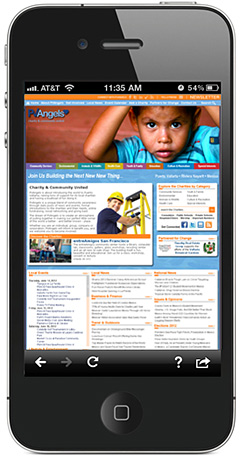 |
To reach people in their 20s and early 30s, the most important thing nonprofits can do is to make sure their websites are easy to read on a mobile device and not overly cluttered, says a survey of more than 6,500 young people released this week.
About 65 percent of respondents said they liked to learn about a nonprofit through its website, compared with 55 percent who said they turned to social networks, email newsletters (47 percent), print (18 percent), and face-to-face conversations (17 percent).
When young adults turn to a website, the “about us” section draws their attention most. Nearly nine in 10 young people said that’s where they go to seek information, according to the survey, conducted by two consulting companies, Achieve and Johnson, Grossnickle, and Associates.
Other information young people want on a website:
- 43 percent said they look immediately for proof about the ways their donations make a difference.
- 41 percent seek volunteer opportunities.
- 41 percent look for an events calendar.
- 30 percent gravitate to videos and photos.
Beyond the information on a website, young people also scrutinize the design.
“Even if you are a small, scrappy nonprofit, your website should look professional,” said one young person quoted anonymously in a report on the survey results. “I judge the character of the organization with its presence on the Web.”
Many young people are looking at charity websites on their smartphones, which 77 percent of the survey participants said they own.
“The mobile device is becoming the entry point and the access point for people to find out about nonprofits,” says Derrick Feldmann, chief executive of Achieve.
'Impulsive Interactions’
Achieve and Johnson, Grossnickle, and Associates conducted the study by distributing a questionnaire through email and social media with the help of 14 organizations, which sent messages to their constituents and donors. Those organizations included several colleges and universities, AmeriCorps Alums, and the social-change group Mobilize.org. The survey was followed up in three cities with focus groups that Achieve conducted to understand how nonprofits could use the results.
Not surprisingly, the speed of Internet communications has led young people to expect “immediate and impulsive interactions” with organizations, according to the report.
Participants in focus groups said they wanted to understand an organization’s mission in less than a second after visiting the Web page.
They also said they turn to mobile sites when they first learn about an organization, trying to get quick information when they are on the go. Young people said they preferred mobile sites that included just the most important information they could act on and that made it easy to click an address or phone number to connect with the nonprofit.
“They said, 'My way has shifted between sitting down and viewing information to standing,’” Mr. Feldmann says.
Mr. Feldmann says nonprofits should expand their thinking about how to use mobile devices beyond seeking text gifts and creating applications.
Focus-group members liked mobile apps but said they didn’t make sense for nonprofits because it’s possible to get information just as easily on a website, and the apps work only on specific devices, such as iPhones or Androids.
Among the study’s other findings:
Keep email newsletters short and to the point. Members of the focus groups said they were more likely to read short, focused emails than long messages. About 65 percent of young people said they wanted emails to give them news about the organization, and 61 percent wanted information about events.
Facebook is the most popular social network. Two-thirds of young people said they interacted with a nonprofit on Facebook, and 92 percent of those respondents “liked” at least one nonprofit’s Facebook page. Three-fourths of people said they would be willing to share an interesting nonprofit event on Facebook.
Twitter is more personal. About 28 percent of young people said they have interacted with a nonprofit on Twitter. Focus-group members said Twitter is especially useful when nonprofit leaders have their own personal accounts and share their views.
Text messages from a charity seem intrusive. Many young people said they would rather not receive text messages from a charity, because they view texts as a form of communication with friends and relatives.
We invite you to add your charity or supporting organizations' news stories and coming events to PVAngels so we can share them with the world. Do it now!
Celebrate a Healthy Lifestyle
 From activities like hiking, swimming, bike riding and yoga, to restaurants offering healthy menus, Vallarta-Nayarit is the ideal place to continue - or start - your healthy lifestyle routine.
 Banderas Bay offers 34 miles of incomparable coastline in the states of Jalisco and Nayarit, and home to Puerto Vallarta and Riviera Nayarit's many great destinations.