
| Unearthing the Truth: Mexican State Violence and Complicity Beyond Ayotzinapa Jesse Franzblau - NACLA.org | |
| go to original December 28, 2014 |
 |
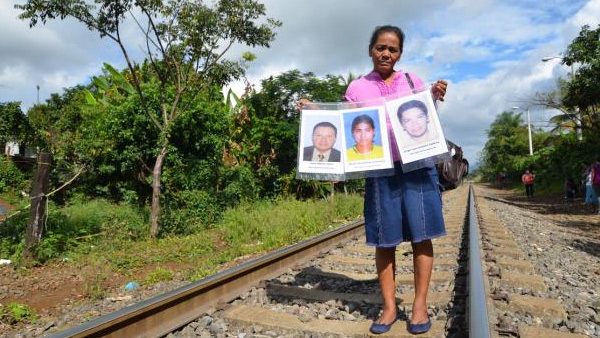
A woman from the Caravan of Mothers, in search of her children (Lucía Vergara/Derecho a la Verdad)
“I feel desperate looking for my daughter because I don’t have any proof, I have questions about everything that they’ve done but they never looked for me; they never handed over evidence,” Mirna del Carmen Solórzano told Mexican news outlet Sin Embargo on March 20, 2014. Similar sentiments have been expressed by family members of the 43 Ayotzinapa rural teachers college students who were disappeared on September 26 at the hands of local and federal police reportedly working in coordination with the drug cartel Guerreros Unidos. But in this case, Mirna’s daughter was found dead over four years prior, in a massacre of Central American migrants that foreshadowed what became deafeningly clear in September: that the Mexican state is frequently complicit in the country’s greatest human rights atrocities.
In what is now called the San Fernando Massacre, Mirna’s daughter and 71 other migrants - many en route from Central America to the United States - were captured and murdered in late August 2010. All public accounts indicate they died at the hands of the criminal organization Los Zetas. While the August 2010 San Fernando Massacre was the most well-reported case of migrant abuse in Mexico at the time, known for its scale and level of atrocity, it was only part of a larger pattern of violence targeting migrants, mostly from Central America, traveling north towards the U.S.-Mexico border. While this case may be seemingly unrelated to the abduction of the 43 Ayotzinapa students, developments in accessing information on the former may have implications on efforts to uncover truth and push for accountability for the later.
Slowly, information on the San Fernando massacre and related violence against migrants is surfacing from behind closed government doors. The dramatic increase in U.S. security assistance programs in Mexico - ushered in through the Mérida Initiative inaugurated in 2008 - paralleled a surge in internal government reporting produced by U.S. officials. Open-government proponents have used the U.S. Freedom of Information Act (FOIA) to gain access to these internal files, which illuminate the links between U.S.-funded counter-drug initiatives and human rights abuses. This article cites a collection of formerly secret declassified files, many of which have been published by the U.S.-National Security Archive (NSA), disseminated by investigative journalists from news outlets such as Proceso and Aristegui Noticias in Mexico, cited as evidence in ongoing legal cases, and used for clarification purposes by a network of activists working to defend migrant rights and increase transparency and accountability for migrant abuses. The slow trickle of such files from the U.S. state archives entails essential clues to understanding the migrant massacres, and is informing the civil society response to the Ayotzinapa disappearances today.
Read the rest at NACLA
Every year, thousands of migrants from Mexico and Central America cross Mexico towards the United States using means and routes which expose them and increase their vulnerability. (Article 19)
We invite you to add your charity or supporting organizations' news stories and coming events to PVAngels so we can share them with the world. Do it now!
Celebrate a Healthy Lifestyle
 From activities like hiking, swimming, bike riding and yoga, to restaurants offering healthy menus, Vallarta-Nayarit is the ideal place to continue - or start - your healthy lifestyle routine.
 Banderas Bay offers 34 miles of incomparable coastline in the states of Jalisco and Nayarit, and home to Puerto Vallarta and Riviera Nayarit's many great destinations.