
| How Abortion Laws in the Americas Compare to Other Countries Around the World Liz Ford and Achilleas Galatsidas - The Guardian | |
| go to original December 8, 2014 |
 |
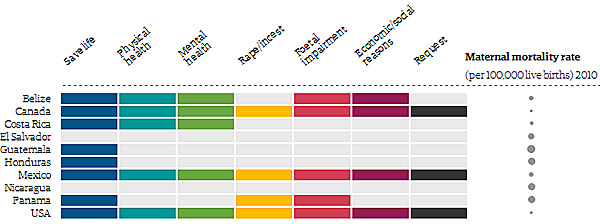
Source: UN world population policies database (2013 revision). Some countries may have amended their laws since this data was gathered. Note that some countries, such as the US and Mexico, have federal laws and laws that differ by state.
Two of the six states in the world that have complete bans on abortion are found in Central America: Nicaragua and El Salvador.
In the US, the 1973 Roe v Wade supreme court ruling gave women the right to abortion. However, some states have introduced restrictions, such as limiting when abortion is allowed, mandatory ultrasounds, and building regulations or medical requirements to make it difficult for abortion clinics to operate. Most states allow abortion up to 24 weeks. In nine states, plus Washington DC, there is no limit.
Canada has no federal restrictions on abortion, but provincial laws vary. There are restrictions on where abortions can take place, and women may need the consent of more than one doctor.
In Mexico, the federal district of Mexico City allows abortion in the first trimester, but most of the country's states have legislated against it or have imposed restrictions.
Compare abortion rights around the world at The Guardian
We invite you to add your charity or supporting organizations' news stories and coming events to PVAngels so we can share them with the world. Do it now!
Celebrate a Healthy Lifestyle
 From activities like hiking, swimming, bike riding and yoga, to restaurants offering healthy menus, Vallarta-Nayarit is the ideal place to continue - or start - your healthy lifestyle routine.
 Banderas Bay offers 34 miles of incomparable coastline in the states of Jalisco and Nayarit, and home to Puerto Vallarta and Riviera Nayarit's many great destinations.