
| Book Review: Mexico in World History Marc Eagle - Western Kentucky University | |
| go to original June 10, 2012 |
 |
 |
|
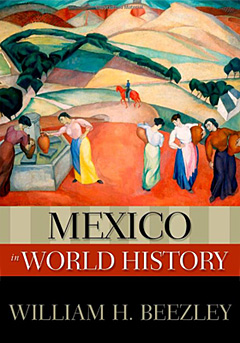
Mexico in World History William H. Beezley Check it out on Amazon.com |
“Mexico in World History,” William H. Beezley’s recent contribution to the New Oxford World History series, provides a wealth of information about Mexico in a brief and accessible format, though it has a few issues.
Beezley, a senior scholar of Mexico who has worked on other textbooks such as “El Gran Pueblo: A History of Greater Mexico” (with Colin MacLachlan) and “The Oxford History of Mexico” (with Michael Deeds), is ideally suited to write a short history such as this.
Beezley begins well before the arrival of the Spanish in the early 1500s with a lively portrayal of the indigenous groups in the region, from the Olmecs to the Maya to the Aztecs. Chapter 2 covers the Spanish conquest of the Aztec Empire together with nearly 300 years of colonial history in a remarkably short amount of space, but manages to convey a sense of the clash and combination of very different cultures and the development of a multiracial society in the territory called New Spain, which quickly became an important part of Spain’s overseas empire.
Beezley then moves on to Mexico’s struggle for independence, made official in 1821, as well as the first few decades of post-independence difficulties. While he does not minimize the major social and political problems the new nation faced, including the rebellion of Texas, Beezley also notes that, according to an 1839 study of Mexico City, “Mexicans lived longer, safer, and more literate lives” (p.52) than their contemporaries in London and Paris.
In Chapters 4 and 5, on the chaotic period from 1844 to 1876 and the generally stable dictatorship of Porfirio Díaz from 1876 to 1911, Beezley seems to warm to his material, seasoning his larger narrative with interesting details on topics like the contests for the words and music of a new national anthem in 1853 or the European-style blond wigs worn by President Antonio López de Santa Anna’s guards. He offers a useful Mexican point of view on the Mexican-American War and the loss of roughly half the nation’s territory in 1848, and provides a clear discussion of the sharp divide between Liberal and Conservative parties that led to a civil war from 1857 to 1861 and a French invasion between 1862 and 1867, during which the country was headed by Austrian-born emperor Maximilian I.
Following the exhausted country’s reconstruction under Benito Juárez, Gen. Porfirio Díaz took control of the country for 31?2 decades starting in 1876, charting a progressive course for Mexico that focused on growth and brought clear benefits to wealthier Mexicans at the expense of the poorer majority of the population. As much of Beezley’s work has focused on this period, his mastery of the scholarship on the Díaz regime shines through with rich insights on Mexican society at the turn of the 20th century.
The topic of Chapter 6 is the Mexican Revolution, often regarded as the central event in the country’s history. For Mexicans, the Revolution was more than just a period of fighting, and so Beezley proceeds quickly through the popular uprisings starting in 1910 to the longer-term struggle for a fairer society for all Mexicans. This was a time of radical social and political change, as the revolutionary government fostered a new sense of pride in the country’s unique Mexican identity. It was not an easy transition, however, and Beezley addresses the complexities of this period, such as the Cristero uprising of 1926-28, in which staunchly Catholic rebels fought against the political marginalization of the church, to the extent of attacking new schoolteachers sent out to rural areas by the government.
By Chapters 7 and 8, the successive presidential administrations become the main structure of Beezley’s narrative; while he continues to add interesting cultural and social notes on topics like sports, music, dress and even comic strips, his political focus sometimes seems to obscure broader social shifts taking place in the country. Despite the revolutionary rhetoric of the government, after the later 1930s life improved for the middle sectors of society, but not for poor Mexicans. The tragedy of the Tlatelolco Massacre, in which the army cracked down on student protests before the Mexico City Olympics in 1968, revealed a government more concerned with stability than social justice. By the later 1980s economic crisis, a near-total lack of emergency response to the major earthquake of 1985, and open electoral fraud had led many Mexicans to lose faith in the ruling party. Presidents after 1988 turned to a neoliberal economic approach, while the Zapatista uprising in the south in 1994 symbolized the underlying problems of social welfare; finally, in 2000, the election of Vicente Fox brought an official end to more than 80 years of revolutionary party rule. Beezley carries his account of recent issues up to 2010, though his emphasis remains on politics, in particular the endemic corruption, and discussion of other important topics like the effects of NAFTA or the rise of drug trafficking and the attendant violence remains disappointingly brief.
“Mexico in World History,” despite its name, is almost entirely an internal history of the country, and although it does cover events that involved other countries (like the Mexican-American War), Beezley does not systematically explore the broader connections between Mexico and the rest of the world. There are also many typographical errors throughout the text, surprising for a well-respected publisher like Oxford University Press, and overall this book would probably have benefited from firmer editorial oversight. Even so, “Mexico in World History” is an excellent survey of the country’s history, perhaps most useful to those who already have some knowledge of the country, but accessible to anyone wishing to develop a solid understanding of Mexico’s past and present.
We invite you to add your charity or supporting organizations' news stories and coming events to PVAngels so we can share them with the world. Do it now!
Celebrate a Healthy Lifestyle
 From activities like hiking, swimming, bike riding and yoga, to restaurants offering healthy menus, Vallarta-Nayarit is the ideal place to continue - or start - your healthy lifestyle routine.
 Banderas Bay offers 34 miles of incomparable coastline in the states of Jalisco and Nayarit, and home to Puerto Vallarta and Riviera Nayarit's many great destinations.