
| Do Your Smartphone Apps Invade Your Privacy? Carnegie Mellon University | |
| go to original November 9, 2014 |
 |
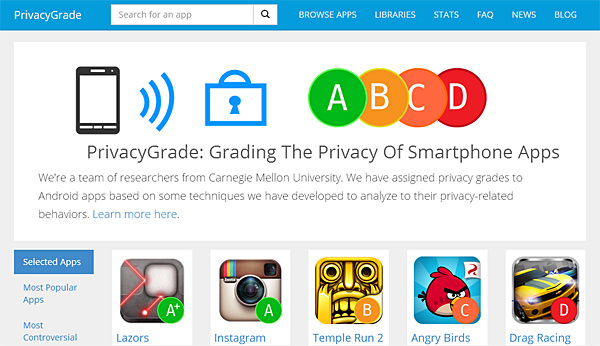
Smartphones wouldn't be so smart without their apps, yet many free apps pinpoint a user's location to deliver targeted ads or share contact lists with third parties without alerting the user. Which apps behave themselves and which don't? A new Carnegie Mellon University project, PrivacyGrade.org, can help sort them out.
The site assigns letter grades to more than one million free Android apps, ranging from an A+ for the puzzle game Lazors to a D for the Despicable Me: Minion Rush game. The grades are assigned automatically using a privacy model that the researchers developed based on the preference ratings of 725 users.
"These apps access information about a user that can be highly sensitive, such as location, contact lists and call logs, yet it often is difficult for the average user to understand how that information is being used or who it might be shared with," said Jason Hong, associate professor in the Human-Computer Interaction Institute, who is leading the research project in the Computer Human Interaction: Mobility Privacy Security (CHIMPS) Lab.
"Our privacy model measures the gap between people's expectations of an app's behavior and the app's actual behavior," he said. "Most people expect apps such as Google Maps to be able to access their location, but most are surprised and troubled to learn that a game accesses their location."
In many cases, location information might be sold to companies that use it to target advertising or to analyze consumer behavior.
Read the rest at IBN
We invite you to add your charity or supporting organizations' news stories and coming events to PVAngels so we can share them with the world. Do it now!
Celebrate a Healthy Lifestyle
 From activities like hiking, swimming, bike riding and yoga, to restaurants offering healthy menus, Vallarta-Nayarit is the ideal place to continue - or start - your healthy lifestyle routine.
 Banderas Bay offers 34 miles of incomparable coastline in the states of Jalisco and Nayarit, and home to Puerto Vallarta and Riviera Nayarit's many great destinations.