
| Mexico City Barter Market Teaches People to Recycle Patrick Ferguson - The News | |
| go to original June 6, 2012 |
 |
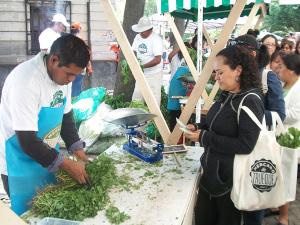 |
| Bring trash, get veggies (The News) |
MEXICO CITY – Tomatoes for cardboard boxes, a bundle of kale for a broken cellphone – these are some of the deals going down at a Mexico City Barter Market.
In Chapultepec park, thousands of people haul in their broken computers, empty glass bottles and old newspapers to the Barter Market monthly, exchanging them for green “bills” to buy organic foods, homemade goods and plants. During the months of March, April and May, more than 20,000 people came out to dump 48 tons of trash.
The project is more of an educational program to teach people to separate their trash rather than a recycling overhaul. In 2003, Mexico City passed a law requiring residents to separate their trash, but due to a lack of infrastructure, unenforced penalties and a weak culture of recycling, things generally haven’t improved.
In December of last year Mexico City made international news when it closed its main landfill, Bordo Poniente, in a bid to reduce carbon emissions and make waste management greener. Still, more than 12 billion tons of garbage is produced in the city every day, of which only a small fraction is recycled.
During the six-hour window the market is running, market-goers walk away with bundles of parsley, bags of tomatoes, jars of honey and plants. Most of the people that come out to the market are aware of the problems facing the environment.
“We want to take care of the environment. When we saw the project, which gives organic food for trash, we thought it’s a good deal. I give them my trash and they give me things I can consume,” said Daniela García.
García explains that the benefits of the program are threefold: recycling goods that might have ended up in a dump, providing people with organic food and supporting local food producers.
But don’t expect a lot of food for your trash. An old cell phone will fetch five points, two points shy of a half-kilo of tomatoes.
Manuel Medina Molina, who sells chapín lettuce plants at the market, said that he participates in the program to do something good for the environment and to teach people about what it takes to grow food.
“We have to work a lot to earn a little,” said Medina Molina, speaking of small-scale food producers.
Medina Molina sells recently sprouted chapín, a type of lettuce that grows from the mud in Xochimilco that people can grow at home and eat within three to four months of planting.
At present the city government pre-pays market vendors for their goods before they sell them for points. Khalil Mackerson, who works at a cooperative supporting sustainable farming, said that ideally, the government wouldn’t be involved in the project and that it would be completely sustainable.
By 2 p.m., the end of the market’s operating hours, long lines still remain but many of the products are sold out.
Lolita María Dolores González, a first-time shopper, said that she wishes that the market had more food in stock, both in terms of quantity and variety, but still, it’s food for trash.
The market is open from 8 a.m. to 2 p.m. on the first Sunday of every month. Products made from glass, paper, cardboard, plastics and electronics are welcome at the market.
We invite you to add your charity or supporting organizations' news stories and coming events to PVAngels so we can share them with the world. Do it now!
Celebrate a Healthy Lifestyle
 From activities like hiking, swimming, bike riding and yoga, to restaurants offering healthy menus, Vallarta-Nayarit is the ideal place to continue - or start - your healthy lifestyle routine.
 Banderas Bay offers 34 miles of incomparable coastline in the states of Jalisco and Nayarit, and home to Puerto Vallarta and Riviera Nayarit's many great destinations.