
| How DNA Barcodes Can Beat Plant and Animal Traffickers Worldwide Nicola Davis - The Guardian | |
| go to original August 17, 2014 |
 |
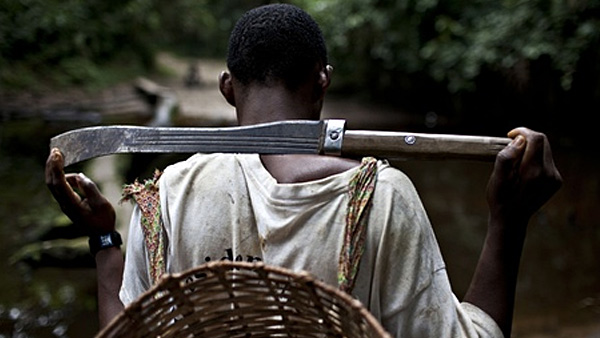
A hunter in Cameroon. It is hoped that DNA barcodes can halt illegal meat trafficking. (Jonathan Torgovnik/Getty Images)
As I rattle across the Welsh countryside in an early morning train, a verdant landscape bounces into view. A blurred jumble of grass, trees, brambles and bushes flies past the window. Catching a lift from Carmarthen station through the Towy valley to the National Botanic Garden of Wales, an even more staggering array of plant life shows itself resplendent. A few I recognize – the heavy boughs of an oak – but most I don't. To me it's just one big, leafy, glorious green vision. Everything looks the same.
But it isn't. As Dr Natasha de Vere, head of conservation and research at the garden, tells me when I arrive that Wales is home to 1,143 native flowering plant and conifer species. And she should know: she has led a team to document each and every one of them using a new approach that could not only revolutionize our ability to label our world, but also help law enforcers clamp down on crimes ranging from seafood fraud to wildlife trafficking.
Taxonomy may have kicked off in earnest with Carl Linnaeus more than 250 years ago, but it didn't end with him: cutting-edge techniques from the burgeoning field of molecular biology are offering fresh approaches to identification. Using them, De Vere and her team of researchers have cataloged the entire native flora of Wales and now, with colleagues at the Royal Botanic Garden Edinburgh, they are extending the resource to cover the whole UK. Its basis? Just two tiny regions of DNA.
Known as "DNA barcodes", these short sections of genetic material allow researchers to identify a species, even when traditional methods such as examining leaf shape or flower parts come a cropper. "Where barcoding really comes into its own is if you want to tell what something is and you have only got a fragment: a single bit of root or even a single pollen grain," says De Vere. "The whole point of DNA barcoding is identification – it is being able to say this is this species, this is that – and the applications that arise from knowing that."
Read the rest at The Guardian
We invite you to add your charity or supporting organizations' news stories and coming events to PVAngels so we can share them with the world. Do it now!
Celebrate a Healthy Lifestyle
 From activities like hiking, swimming, bike riding and yoga, to restaurants offering healthy menus, Vallarta-Nayarit is the ideal place to continue - or start - your healthy lifestyle routine.
 Banderas Bay offers 34 miles of incomparable coastline in the states of Jalisco and Nayarit, and home to Puerto Vallarta and Riviera Nayarit's many great destinations.