
| Who Can You Trust? TV, Internet and Power and the New Mexican Telecommunications Law Sarahy Sigie and Juan Villalobos - Flip the Media | |
| go to original July 21, 2014 |
 |
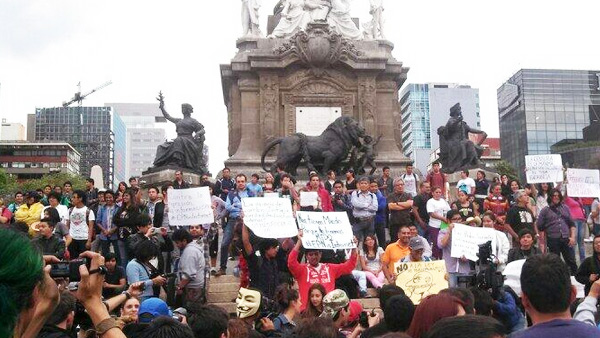
Protesters gather in Mexico City to march against new internet privacy laws. (Twitter/@tanlmont)
In the first season of the hit show House of Cards, Congressman Frank Underwood uses an eager young reporter of a Politico-style upstart news website to win support and discredit rivals. Newspapers, radio, broadcast TV – old media – are no longer the preferred partners for ambitious politicians, it’s the web that drives the story.
While the US already grapples with the pro and cons of a digital democracy, in Mexico a fight continues over the role of the internet in politics. Free, over-the-air TV is still the main source of information and entertainment for Mexicans, only 30% of the population has Internet access. But even though the web has no real influence on the political decision-making of most Mexicans, it seems likely that growing internet access will change they way people get information.
The Institutional Revolutionary Party (PRI), Mexico’s sole ruling party until 2000 and back in power after the most recent election, seems unwilling to make this shift. In April the PRI-led government send a new, highly controversial Telecommunications Law to the Senate. Opponents declared it incompatible with the Constitution, especially the articles referring to freedom of speech and competence, which seemed to favor Televisa, Mexico’s biggest TV broadcaster.
The proposed law included articles and sections designed to limit fundamental rights. The biggest concerns were provisions for banning contents “contrary to established norms” (article 145), intervening in private conversations and storage of customer data (art. 190), and the obligation of Internet providers to shut down the service in areas or during events considered “critical” for national security. In all these cases, Internet and pay-TV companies were supposed to cooperate with the “qualified authorities”in charge of making these requests.
Why such a heavy-handed approach to online regulation? Let’s rewind for a moment and take a quick look on the intersection of TV, politics and power in Mexico’s history.
Read the rest at Flip the Media
We invite you to add your charity or supporting organizations' news stories and coming events to PVAngels so we can share them with the world. Do it now!
Celebrate a Healthy Lifestyle
 From activities like hiking, swimming, bike riding and yoga, to restaurants offering healthy menus, Vallarta-Nayarit is the ideal place to continue - or start - your healthy lifestyle routine.
 Banderas Bay offers 34 miles of incomparable coastline in the states of Jalisco and Nayarit, and home to Puerto Vallarta and Riviera Nayarit's many great destinations.