
| Central American Migrants Step Out of Shadows and Into Mexico's Streets Martha Pskowski and Alex Mensing - CIP Americas | |
| go to original June 7, 2014 |
 |
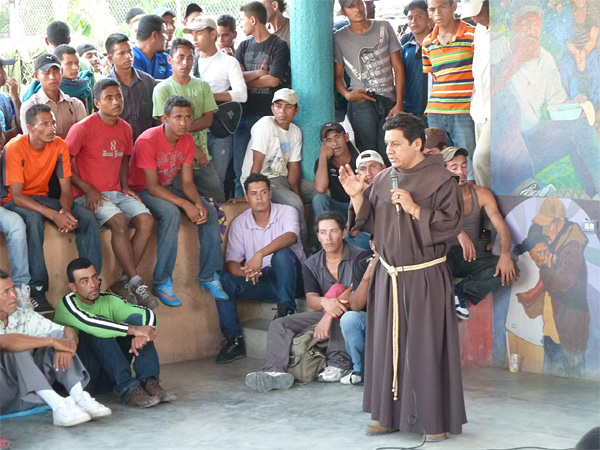
“Nosotros decidimos entre todos hacer una caminata hasta Palenque.”/“All of us, together, have decided to walk to Palenque.”
 |
Eighty kilometers separate Tenosique, Tabasco, from Palenque, Chiapas. By the end, the walk that started in Tenosique ended up all the way in Reynosa, Tamaulipas, on the border with the United States.
This is the story of that walk and the people who decided to take it.
Without papers or protection, Central Americans migrating through Mexico must evade detection by Mexican immigration officials who may detain and deport them, state and federal police who commonly subject them to extortion, and organized crime on the local, national and transnational levels who have made them a prime target for robbery, kidnapping and murder. So it is no surprise that the issue of Central American migration through Mexico remains invisible to most Mexicans. They have to be invisible to survive.
But in the Mexican states of Tabasco, Chiapas and Veracruz, the dangers being invisibile are becoming even greater than the risks of being seen by the law.
Boarding the train in Tabasco and southern Veracruz has become a matter of life and death. By February of this year, every week or two news articles reported on migrants killed for not paying the “quota.” The maras – the Central American gangs who terrorize migrants throughout the country – demand that migrants hopping the train pay $100 each.
The largest of these gangs, the Mara Salvatrucha 13 and Barrio 18, have created alliances with the Zetas and the Gulf cartels that operate along the migrant routes. The cartels have bought off local police agents and Immigration officials in many places, allowing their drug trafficking, kidnapping and extortions operations to continue without prosecution.
In recent weeks, the freight train operators stopped letting migrants board “La Bestia,” the cargo train they ride to the center of the country. While the train is dangerous, being abandoned along the route left many as sitting ducks.
On March 31, Veracruz Gov. Javier Duarte brought a lawsuit to the Attorney General against the train companies Ferrocarriles Sur and Kansas City Group, arguing that they are responsible for the murders, injuries and extortions that migrants face when they hop the train. Duarte argued that the case would compel the companies to address the problems aboard the trains.
But critics such as Rubén Figueroa of the Mesoamerican Migration Movement (MMM) say the case only makes migrants more vulnerable and does nothing to solve the problems. Without any other option, in early April hundreds of migrants began to gather in Tenosique, having heard about the “Viacrucis del Migrante,” which they hoped would help them make the first leg of their journey safely.
Read the rest at CIP Americas
We invite you to add your charity or supporting organizations' news stories and coming events to PVAngels so we can share them with the world. Do it now!
Celebrate a Healthy Lifestyle
 From activities like hiking, swimming, bike riding and yoga, to restaurants offering healthy menus, Vallarta-Nayarit is the ideal place to continue - or start - your healthy lifestyle routine.
 Banderas Bay offers 34 miles of incomparable coastline in the states of Jalisco and Nayarit, and home to Puerto Vallarta and Riviera Nayarit's many great destinations.