
| US-Mexico Border Wreaks Havoc on Lives of An Indigenous Desert Tribe Kate Kilpatrick - Al Jazeera | |
| go to original May 25, 2014 |
 |
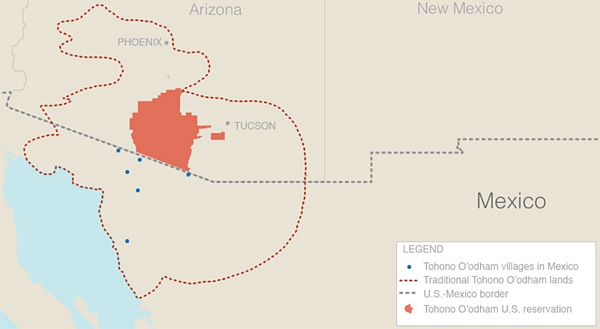
A map shows the reservation for the Tohono O'odham in the United States and an approximation of traditional lands on both sides of the border. (Handbook of North American Indians, Vol. 10: Southwest, O'odham Solidarity Across Borders Collective; Resource Center at the National Museum of the American Indian, New York)
SAN MANUEL, Mexico — Jesús Manuel Casares Figueroa needs a catheter or he will die. His bloated chest pressed against his blue jacket as he sat in a wheelchair in front of his uncle’s modest concrete-block home, one of a handful in this traditional village of the O’odham in the Sonoran desert. His mother touched a gold-colored earring that dangled from Jesús Manuel’s left ear. Her son was born with spina bifida, she explained, and a chronic kidney infection has complicated his condition.
In February, the doctor said Jesús Manuel urgently needed the operation. His family didn’t have the money then, and they don’t have it now.
So in a few hours mother and son will go door to door asking for donations in the neighboring O’odham village, about 60 miles south of Nogales.
For thousands of years, the Tohono O’odham (meaning “Desert People”) inhabited what is today southern Arizona and the northern state of Sonora in Mexico. But the O’odham were there long before either Mexico or the U.S. existed as nations. “We’ve always been here,” said Amy Juan, 28, a young activist on the reservation. “Nobody can argue that we weren’t here first.”
Read the rest at Al Jazeera
We invite you to add your charity or supporting organizations' news stories and coming events to PVAngels so we can share them with the world. Do it now!
Celebrate a Healthy Lifestyle
 From activities like hiking, swimming, bike riding and yoga, to restaurants offering healthy menus, Vallarta-Nayarit is the ideal place to continue - or start - your healthy lifestyle routine.
 Banderas Bay offers 34 miles of incomparable coastline in the states of Jalisco and Nayarit, and home to Puerto Vallarta and Riviera Nayarit's many great destinations.