
| Scientists Confirm a Massive Asteroid Impact on the Yucatan Ended the Age of Dinosaurs CBS Houston | |
| go to original May 14, 2014 |
 |
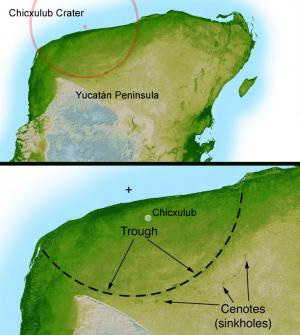 |
| Yucatan chix crater (NASA) |
A massive asteroid slammed into the Earth 66 million years ago, setting off a decades-long “impact winter” in which a blanket of ash blocked sunlight and caused a severe drop in global surface temperatures, new sediment research concludes.
The study from Johan Vellekoof and his team at Utrecht University in the Netherlands concludes that the space rock’s impact some 66 million years ago caused a vast blanket of ash and silt to block out the sun. The ashy darkness halted photosynthesis, caused sea surface temperatures to fall an average of 2 degrees and ultimately led to the demise of the dinosaurs.
The asteroid collided with Earth near present-day Chicxulub, Mexico, and the researchers studied ocean microbe lipids preserved within the silt in the Brazos River region of central Texas in order to reconstruct sea surface temperatures from the dinosaur period.
The data showed that waters were warm before the impact, around 30 degrees Celsius. But in the decades following, sea surface temperatures dropped an average of 2 degrees as light and heat from the sun were blocked by the blanket of dust blasted skyward by the asteroid collision.
Read the rest at CBS Houston
We invite you to add your charity or supporting organizations' news stories and coming events to PVAngels so we can share them with the world. Do it now!
Celebrate a Healthy Lifestyle
 From activities like hiking, swimming, bike riding and yoga, to restaurants offering healthy menus, Vallarta-Nayarit is the ideal place to continue - or start - your healthy lifestyle routine.
 Banderas Bay offers 34 miles of incomparable coastline in the states of Jalisco and Nayarit, and home to Puerto Vallarta and Riviera Nayarit's many great destinations.