
| Maya Predicted the World Would Continue Robert T. Gonzalez - io9.com | |
| go to original May 13, 2012 |
 |
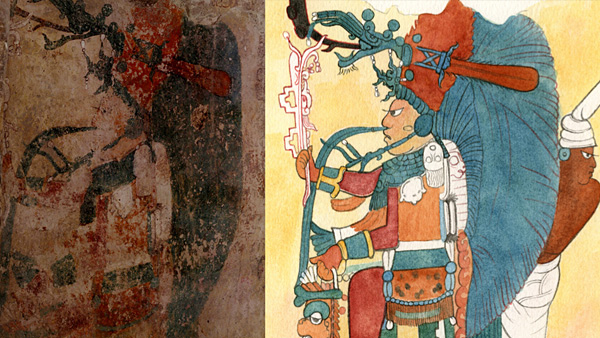
In the oldest Maya Calendar ever discovered is a mural of a Maya king seated atop a throne - depicted here alongside a reconstruction by archaeological illustrator Heather Hurst. (National Geographic)
For years, archaeologists have referred to an ancient set of texts known as the Maya codices to study that ancient civilization's relationship with astronomy and time. But now, a team of archaeologists has discovered a set of murals, hieroglyphs, and astronomical calendars deep in the rainforests of Guatemala, that predate those texts by hundreds of years.
Oh, and check your 2012 conspiracies at the door. According to these newly discovered charts, the Maya were in it for the long-haul.
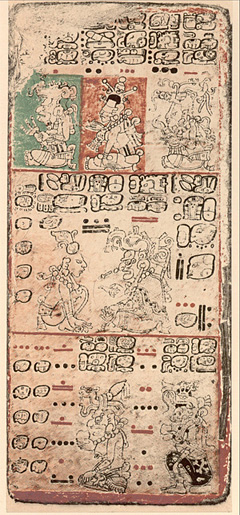
Almost everything we know about Maya astronomy — their charting of the Sun, their tracking of the Moon and planets — we've learned from the Maya codices, a trio of intricately illustrated books carefully assembled out of a rugged cloth crafted from the inner bark of fig trees.
Each codex — The Madrid Codex, the Dresden Codex, and the Paris Codex — is filled with hieroglyphic script and astronomical tables like the ones pictured here. This particular leaf of bark cloth comes from the Dresden Codex. The scribes who penned these charts and figures are thought to have lived a century or two before the arrival of Columbus. It is the oldest known book ever written in the Americas.
It is not, however, the earliest known Maya astronomical calendar. At least, not any more.
In today's issue of Science a research team led by Boston University archaeologist William Saturno describes the recent discovery of Maya murals, hieroglyphs and astronomical calculations that date all the way back to the 9th century. Not only do these paintings predate the Dresden Codex by hundreds of years, they are also the first known evidence of Maya astronomical methodology from what's known as the Classic period — the time span ranging from 200 to 900 C.E.
An Unlikely Find
The discovery was made in a small, sub-surface dwelling located in Xultún, Guatemala — one of the largest Maya archaeological sites on Earth.
"Xultún is a city that takes up at least 16 square kilometers," Saturno told reporters earlier today in a press conference. Thousands of Maya structures, some as tall as 35 meters in height, have been found rising up from the region's rain forest floor.
For as expansive as Xultún is, it has been the subject of very few official archaeological investigations since it was first discovered in 1915. What attention it has received has come in the form of looting. These illicit investigations, say the researchers, have left the largest mark on the site; much of Xultún's archaeological richness has been plundered, or eroded over time by the region's punishing climate.
That's not to say official studies aren't conducted, or that discoveries aren't made. Saturno, himself, was involved in one such investigation in March, 2010, when a member of his team — Maxwell Chamberlain — happened upon the small, masonry-vaulted structure. The dwelling had already been partially exposed by looting, but when Chamberlain peered inside, he was met by the structure's western wall, and identified what he believed to be a heavily eroded mural painting.
To the untrained eye, what Chamberlain had spotted probably looks no different from a bare slab of rock, but something was definitely there. "Maya paintings are incredibly rare," explains Saturno, "not because [the Maya] didn't paint, but because they rarely stay preserved in the Guatemalan climate."
Researchers often find walls with remnants of paint, but very rarely can anything be said about their previous artistic content. Such was the case with the mural that Chamberlain had discovered. It was a noteworthy find, to be sure, but nothing earth-shattering in the grand scheme of things.
But then the researchers started digging.
"We decided to look at how big the room was," explains Saturno. The team burrowed North, searching for the rear wall of what they knew to be a small room, a room they determined would require minimal effort in the way of excavation. The researchers reached the wall quickly; they had been right about the size of the room. But what they found there nobody could have anticipated.
It was a mural of a Maya king, seated atop a throne. The mural depicted above is alongside a reconstruction by archaeological illustrator Heather Hurst. According to Saturno, the painting has been color matched to the chemical components of the pigments used by the original painter (determined using a preservation technique known as chemical fluorescence), revealing the color this painting would have been prior to enduring centuries of deterioration.
Read the full story on io9.com
We invite you to add your charity or supporting organizations' news stories and coming events to PVAngels so we can share them with the world. Do it now!
Celebrate a Healthy Lifestyle
 From activities like hiking, swimming, bike riding and yoga, to restaurants offering healthy menus, Vallarta-Nayarit is the ideal place to continue - or start - your healthy lifestyle routine.
 Banderas Bay offers 34 miles of incomparable coastline in the states of Jalisco and Nayarit, and home to Puerto Vallarta and Riviera Nayarit's many great destinations.