
| In North America, the World’s Deadliest Animal Is on the Move Shannon Osaka - The Washington Post | |
| go to original July 2, 2023 |
 |
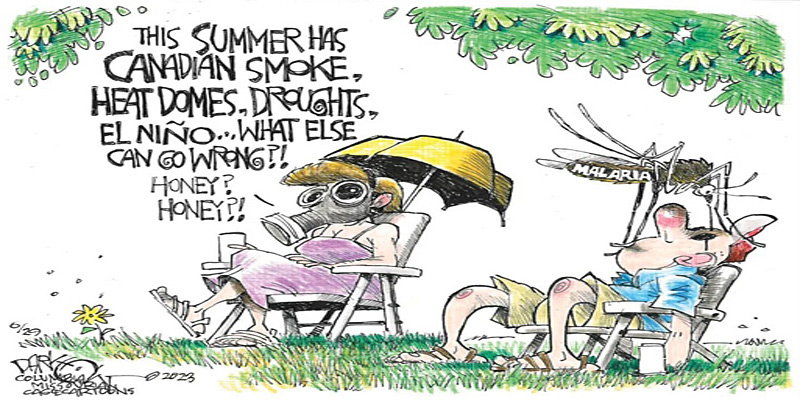
The deadliest animal in the world is smaller than a pencil eraser and weighs around two-thousandths of a gram — less than the weight of a single raindrop. Every year, it kills an estimated 700,000 people by partaking in what scientists grimly call a “blood meal.”
It’s the mosquito — and, increasingly, it’s on the move.
These global shifts, which will only accelerate as the planet warms, have sparked concern that the diseases mosquitoes carry will exact an even higher toll in the months and years to come.
In June alone, five cases of locally transmitted malaria were discovered in Texas and Florida: the first cases acquired in the United States in two decades. These cases, experts say, are unlikely to have a connection to warming temperatures — conditions in Florida and Texas are already suitable for malaria-carrying mosquitoes. But as urban heat islands expand and temperatures rise, mosquito-borne diseases are expected to travel outside of their typical regions.
“Climate change allows the creeping edge of mosquito ranges to expand,” said Sadie Ryan, a professor of medical geography at the University of Florida.
Earlier this year, Georgetown University researchers published a paper in Biology Letters demonstrating that malaria mosquitoes’ ranges have already shifted in Africa over the past century, farther from the equator and into higher altitudes.
Malaria cases worldwide declined steadily for nearly two decades. But that progress stalled as cases have flatlined and even ticked up in some countries in the past few years. Cases increased to an estimated 247 million in 2021 from a recent low of 231 million in 2018, according to data from the World Health Organization.
Mosquitoes don’t kill the way a shark or a lion does: Instead, they are “vectors” for many painful and life-threatening diseases, from dengue fever to malaria to chikungunya. When a mosquito “bites” someone — by stabbing a needle-filled proboscis deep into a blood vessel — it both sucks out blood and leaves some of its own saliva behind.
That saliva, when contaminated by virus or parasite, can make people sick, often painfully so. Dengue fever is also known as “breakbone” fever; the name chikungunya comes from an African word meaning “to be contorted,” as patients often bend over from severe joint and muscle pain.
And there is reason to think that those excruciating and sometimes deadly diseases will spread as temperatures warm. Like all insects, mosquitoes are coldblooded and rely on ambient temperatures to sustain their body temperatures. They thrive, particularly, on temperatures between 50 and 95 degrees Fahrenheit — and, unlike most humans, who wilt under high humidity, mosquitoes love damp air.
Read the rest at The Washington Post
We invite you to add your charity or supporting organizations' news stories and coming events to PVAngels so we can share them with the world. Do it now!
 Banderas Bay offers 34 miles of incomparable coastline in the states of Jalisco and Nayarit, and home to Puerto Vallarta and Riviera Nayarit's many great destinations.