
| 1940s Mexico Has a Lesson for How the U.S. Can Tackle Drug Addiction Lauren Mehfoud - The Washington Post | |
June 22, 2023 |
 |
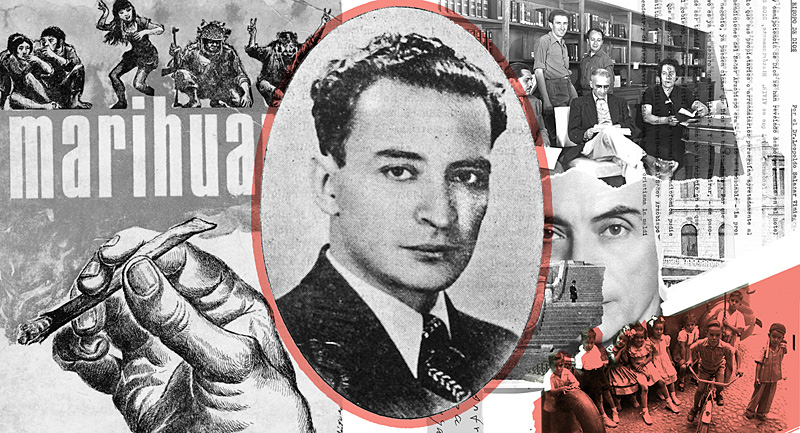
Policies that treat drugs as an issue of public health — not just a criminal justice problem — are increasingly receiving bipartisan support across the United States. With the backing of Republican lawmakers, states like Kentucky, Mississippi and Utah recently decriminalized fentanyl test strips in an effort to reduce overdose deaths. Access to resources aimed at minimizing the harm associated with drug use, including needle exchange and naloxone distribution programs, is also expanding throughout the country. More divisive strategies, such as supervised injection sites, remain limited to areas like New York City.
But harm reduction is far from a new idea. While we frequently hear U.S. politicians and media outlets cast blame on Mexico for the rising number of drug-related deaths in the United States, Mexico has long been a model for harm reduction. In fact, more than 80 years ago, Mexico decriminalized drugs and opened a state-run morphine dispensary in the nation’s capital. Although the Mexican government was forced to end this experiment after only five months, this moment in history demonstrates how Latin American countries — in contrast to how they are frequently depicted in U.S. media — have often been at the forefront of thinking about alternatives to drug prohibition.
In 1939, a Mexican doctor named Leopoldo Salazar Viniegra proposed an audacious plan to treat drug addiction that he claimed would also eliminate the illegal drug trade. At the time, he was leading the government’s Campaign Against Alcoholism and Other Drug Addictions and teaching medical courses at the National Autonomous University of Mexico (UNAM). He also served as the director of the federal Psychiatric Hospital in Mexico City, where he researched drug use and addiction.
Salazar was also well-known for his eccentric behavior. He once shot a hole through the door of another employee’s house while doing target practice on hospital grounds, and in another instance, invited drug users to inject themselves with morphine in front of a class of medical students. Sparking an uproar, he claimed that his research showed cannabis was not addictive and posed no danger to its consumers. To prove this point, he often gave marijuana-laced cigarettes to unsuspecting acquaintances, including politicians and, on one accidental occasion, a group of children.
Despite his peculiarities and risky behavior, Salazar remained a respected medical authority on drug addiction, and in 1940, the Mexican government put many of his ideas into action. Over the previous two decades, conservative Mexican presidents had subjected drugs to increasingly harsh punishments based on the belief that these substances would “degenerate the race.” This belief was rooted in eugenic ideas about improving the “human race” and was tied to ongoing nationalistic anxieties regarding Mexico’s racial identity. Although these racist ideas did not disappear entirely, by the 1930s, a group of Mexican doctors led by Salazar had begun to refute these pseudoscientific claims. In 1940, a more liberal president, Lázaro Cárdenas, permitted Salazar to put these ideas into practice, ushering in a major, albeit brief, reversal of Mexican drug policy.
This plan immediately decriminalized drugs and on March 9, 1940, a state-run morphine dispensary opened in the heart of Mexico City. There, doctors began administering daily injections to treat hundreds of diagnosed drug addicts.
Its successful treatments hinged on a different approach to drug use. Salazar believed that addiction was more of a physical illness than it was a criminal behavior. Criminalizing people for being addicted to drugs, he reasoned, was a lot like punishing a patient for being sick.
Through years of clinical practice and research, Salazar had arrived at the conclusion that addiction — particularly to opiates like heroin, morphine and opium — was treatable, but nearly impossible to cure. So, instead of seeking to eliminate someone’s dependency on drugs, he sought to provide those experiencing addiction with safe, reliable and affordable doses of morphine that would help them return to their normal lives.
Read the rest at The Washington Post
Related: Meet the Revolutionary Doctor Who Legalized Drugs in Mexico Back in 1940 (MerryJane)
 Learn about Husania - Humanity, Healing & Wellness
Learn about Moffitt Wellness Retreat
Learn about Clínica de Rehabilitación Vallarta
Learn about Rē Precision Health
We invite you to add your charity or supporting organizations' news stories and coming events to PVAngels so we can share them with the world. Do it now!
 Banderas Bay offers 34 miles of incomparable coastline in the states of Jalisco and Nayarit, and home to Puerto Vallarta and Riviera Nayarit's many great destinations.