
| The Dire Health Consequences of Denying Abortions, Explained Dylan Scott - Vox | |
| go to original May 5, 2022 |
 |
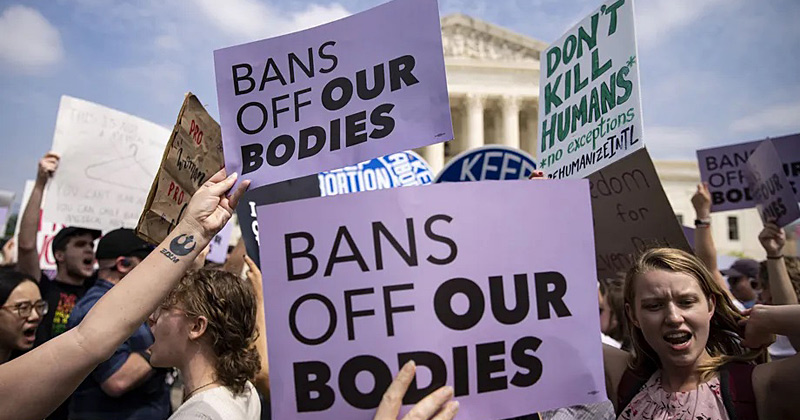

“For every outcome we analyzed, women who received an abortion were either the same or, more frequently, better off than women who were denied an abortion,” the lead researcher of a landmark study on abortion wrote. (Al Drago/Bloomberg)
The overturn of Roe v. Wade, possibly presaged this week in the leak of a draft Supreme Court opinion, would be a development of enormous political and social consequence. Most fundamentally, however, such a ruling could almost immediately trigger tectonic change in the health and well-being of birthing people and children across the country.
We know this due to important research published in 2020 that compared the fates of women who were forced to carry pregnancies to term versus those who were provided abortions. The influential Turnaway Study, as it’s commonly referred to, found that, among other things, women who were denied an abortion endured more serious pregnancy complications, more chronic pain, and more short-term anxiety.
The Supreme Court’s decision is not final: Opinions go through many drafts, and, in theory, some of the justices could still change their minds before handing down their final decision in Dobbs v. Jackson Women’s Health Organization.
A leaked draft opinion on May 2 shows that the Supreme Court is poised to overturn federal abortion protections. Here's what would happen. (Joshua Carroll/The Washington Post)
Yet if the court were to issue a ruling along the lines of what Justice Samuel Alito has drafted — as published this week by Politico — more than 20 states are expected to immediately ban abortion in most cases, with half of those having “trigger laws” already on their books (meaning abortion bans that would take effect almost immediately if Roe were overturned). In an instant, a common medical service that has been constitutionally protected for nearly half a century would be outlawed in almost half the country.
The precise effect of such a sweeping loss in abortion access is impossible to know from our vantage point in time. In many of these states, abortion access has already dwindled over the years as state legislators passed onerous restrictions aimed at forcing clinics to shut down — half-measures they could take until a conservative majority on the nation’s high court, as there is currently, could overturn Roe outright.
Many pregnant people rely on mail-order pills for abortions, and President Joe Biden’s administration has pledged to safeguard access for them (though anti-abortion states are already attempting to restrict access to those drugs). Some seeking an abortion may also travel to another state where abortion is still legal, though, because of the cost, it would likely be more privileged people who are able to take advantage of that option. Still, both options could help limit the consequences of a decision overturning Roe.
Nevertheless, it’s inevitable that more unwanted pregnancies would be carried to term if the court were to negate a federal right to abortion. Diana Greene Foster, a professor at the University of California San Francisco and the lead researcher on the Turnaway Study, which analyzed how women who received an abortion and women who were denied one were affected by that important juncture in their life, roughly estimates that between one-quarter and one-third of women with an unwanted pregnancy will bring the pregnancy to term if Roe is overturned.
Foster and her colleagues have given us a strong idea of the health, social, and economic consequences of outright abortion bans. The Turnaway Study began in 2007 and followed more than 1,000 women for five years to assess how their lives had been altered, if at all, by the provision or the denial of an abortion. Some of the women had an abortion shortly before reaching the gestational limit set by their state or provider, while others had just passed that limit and were denied an abortion as a result. The differences in the women’s experiences from that critical moment onward were the purview of the study.
Read the rest at Vox
George Carlin-Pro-Life Is Anti-Woman! (Mickey Mouse)
Related: Mexico Sees an Increase in Sales of Abortion Drugs to Women From the US (NPR)
Related: Abortions in Mexico? If Roe v. Wade Is Overturned, Women Will Still Have Options (USA Today)
Related: Abortion Is No Longer a Crime in Mexico. But Most Women Still Can’t Get One (The New York Times)
Related: Meet the Reddit ‘Aunties’ Covertly Helping People Get Abortions (The Washington Pos)
Related: The Biggest Health Risks Women Would Face if Roe v. Wade Is Overturned (NBC News)
Related: Overturning Roe Threatens Women’s Health in So Many Ways (The Washington Post)
Related: Why You Should Donate to an Abortion Fund, Not Planned Parenthood (Vice)
Related: How Women Across the Country Are Talking About the Possible End of Roe (Washington Post)
Related: How Colombian Feminists Decriminalized Abortion: With Help From Their Neighbors (The New York Times)
We invite you to add your charity or supporting organizations' news stories and coming events to PVAngels so we can share them with the world. Do it now!
 Banderas Bay offers 34 miles of incomparable coastline in the states of Jalisco and Nayarit, and home to Puerto Vallarta and Riviera Nayarit's many great destinations.