
| Demand for Service Dogs Unleashes a ‘Wild West’ Market Markian Hawryluk - KHN | |
| go to original February 22, 2022 |
 |
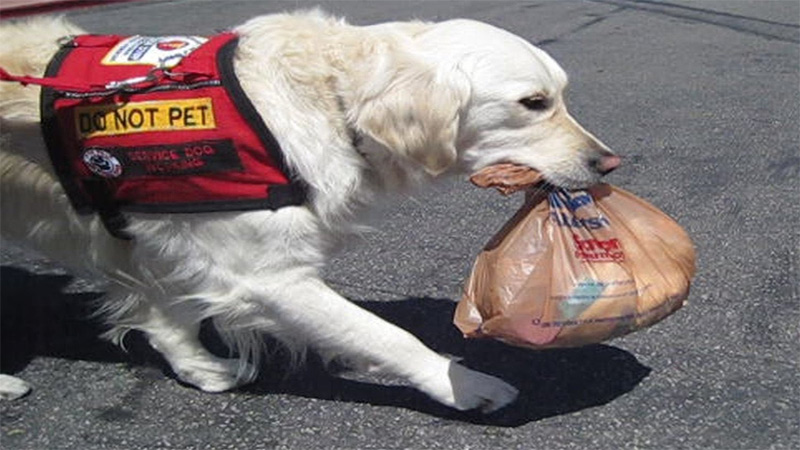
Demand for service dogs has exploded in recent years as dogs have proved adept at helping children and adults with an increasing range of disabilities. While dogs once served primarily people with vision or mobility impairments, they now help people with autism, diabetes, seizures, and psychiatric disorders. That has overwhelmed nonprofit service dog trainers, who generally donate dogs to patients for at most a small application fee. But unmet needs have helped launch a for-profit service dog industry with hefty price tags.
Rapid growth, however, has come with little oversight, potentially subjecting people who have complex medical issues to huge financial barriers, poorly trained dogs, and outright fraud. Those pitfalls are only exacerbated by social media, including fundraising sites like GoFundMe that allow families to meet pricing thresholds they wouldn’t be able to afford on their own. The flourishing market emboldens trainers to charge more for their services, confident that the funds will be donated.
Some gamble by training their own dogs to lower the cost. But trainers say that the success rate for self-trained dogs is lower than their own — and that families could be out thousands of dollars.
The lack of regulations for service dog trainers has opened the door for scores of backyard trainers who may or may not be qualified to train service dogs, said Lynette Hart, a professor of veterinary medicine at the University of California-Davis. There is no certification process for service dogs, either.
“There’s a big opportunity for people who are dog trainers to say, ‘Oh, I will sell you one for tens of thousands of dollars,” she said. “It’s a kind of a wild West issue.”
But that also leaves families open to getting burned with little recourse.
“Sometimes they’re sold a bill of goods,” said Sheila O’Brien, chairperson of the North American board of Assistance Dogs International. The group accredits service dog trainers, but the accreditation is voluntary and only nonprofit organizations are eligible. The group has 80 accredited members and 25 candidate programs in North America. But nobody knows how many unaccredited dog trainers are operating in the U.S.
“It’s so easy to defraud people over the internet. There’s a lot of money to be made here,” said David Favre, a Michigan State University law professor specializing in animal law. “It’s never been controlled, and it’s gotten worse.”
Read the rest at KHN

We invite you to add your charity or supporting organizations' news stories and coming events to PVAngels so we can share them with the world. Do it now!
 Banderas Bay offers 34 miles of incomparable coastline in the states of Jalisco and Nayarit, and home to Puerto Vallarta and Riviera Nayarit's many great destinations.